Showing posts with label Russia Launcher and MISSILE. Show all posts

Wednesday, December 8, 2010

Russia Defense Security Submarine Launched Ballistic Missile Systems (SLBMs)

Russia Submarine Ballistic Missile System Series: Delta III/SS-N-18 (STINGRAY), Delta IV/SS-N-23 (SKIFF) , Typhoon/SS-N-20 (STURGEON),  Borei/SS-NX-28 and Bulava-30

Russia currently has three primary SLBM platforms: the Delta III, Delta IV and the Typhoon class submarines. These nuclear powered ballistic missile submarines, referred to as SSBNs, are based on the Kola Peninsula in northern Russia and on the Kamchatka Peninsula in the Russian Far East. Current Russian doctrine dictates that ballistic missile submarines should deploy in waters close to Russian landmass, since these patrol areas (known as bastions) can be protected by aircraft, sonar networks, surface ships and Russian attack submarines. Additionally, it should be noted that the Russian SSBN force is capable of striking most of the CONUS from pier-side, reducing the need to deploy well away from Russian shores.
  
Delta III/SS-N-18 (STINGRAY) Submarine Missile
The Delta III carries the two-stage SS-N-18, the first MIRV’d Soviet SLBM. This submarine carries 16 missiles, each with three MIRV warheads. Following implementation of START I and II, it is expected that some of the SS-N-18s will be withdrawn from service. There remain questions regarding the future size of the Russian SSBN force. A revised Russian plan suggests that the entire Delta III class may be retired in the next decade.
  
Delta IV/SS-N-23 (SKIFF)  Submarine Launched Ballistic Missile Systems
A three-stage liquid-propellant SLBM was tested in 1983 from a submarine designated the Delta IV. This SLBM was designated as the SS-N-23 and is more accurate than the SS-N-18. The SS-N-23 is about 47 feet long, carries up to 10 MIRVs and has a range of 4,500 nm.

All seven Delta IV submarines are based on the Kola Peninsula, with protected bastion patrol areas in the nearby Barents Sea and easy access to the Arctic. Even though the SS-N-23 has the capability to carry 10 MIRVs, it is counted as carrying four MIRVs under the START agreements. Four is the number of warheads per missile postulated for future deployment.

Typhoon/SS-N-20 (STURGEON) Submarine Launched Ballistic Missile Systems
The SS-N-20 SLBM was first identified in the early 1980s. The missile test program was unsuccessful during its early stages. However, following the first Typhoon submarine launch in September 1980, subsequent successful missile tests from the submarine moved the program ahead. The Typhoon’s SS-N-20 weapon system was declared operational by Western sources in 1984.

The SS-N-20 is a three stage, solid-propellant missile capable of carrying between 8 to 10 RVs, with a maximum range of approximately 4,300 nm. This range gives it the capability to operate within Russian waters and still strike targets on the North American continent.

The Typhoon is the largest operational SSBN in the world. This submarine is approximately one third larger than the U.S. Ohio Class SSBN. It is estimated to have been designed to conduct missile patrols under the Arctic Ocean ice cap. Six Typhoons are estimated to be operational, each with 20 launch tubes and a total weapon capacity of 120 SS-N-20 missiles carrying 960 warheads. Delta IV with missile hatch open A unique feature of the Typhoon is that its missile bays are located forward of the submarine’s sail. All other Russian and U.S. SSBNs have their missile bay behind the sub’s sail.

 Borei/SS-NX-28 and Bulava-30 Submarine Launched Ballistic Missile Systems
that a follow-on to the SS-N-20 was being developed, the SS-NX-28. Little is known about this system, however there have been reports of numerous difficulties with the system. There have been four test launches of the SS-NX-28, the latest in November 1997. None of the launches have been successful. Like the ICBM's, much of the former Soviet SLBM systems were build in the Ukraine, so Russia has had difficulties in building such missile systems.

A new class of SSBN was envisioned for this new missile system, the Borei. The first of these fourth generation submarines was started in 1996 but lack of funding and the SS-NX-28 problems has significantly delayed construction. Both the SS-NX-28 and Borei programs have been cancelled due to technological and economic roadblocks. Russia has announced a replacement system called the Bulava-30. A new SSBN, called the “Dolgoruky” will carry the new missile, which has a range of 8,000+ km.

Sunday, December 5, 2010

SHMEL Infantry Rocket Flamethrower By Russia

SHMEL ROCKET LAUNCHERS

The Shmel disposable flamethrower is employed to increase combat capabilities of the ground forces. It is designed to attack personnel and weapon systems in various covers, as well as to destroy fortifications, automobiles and lightly armoured vehicles, and set fire and generate smoke screens.

Features
Shmel is most effective in terrains, where artillery or armoured vehicles are restricted, i.e. in mountains, built-up areas, forests, on the plain when roads are impassable, or when enemy aviation and artillery enjoy obvious superiority, and also in ranger (guerrilla) operations. The flamethrower can be fitted with three types of warheads:

• RPO-A (thermobaric) warhead, used to attack protected weapon systems in built-up areas, fields, mountains, as well as to destroy covers, automobiles and lightly armoured vehicles; • RPO-Z (incendiary) warhead, used to set landscape, buildings, and oil depots on fire;
• RPO-D (smoke) warhead, used to set up smoke screens, blinding weapon system crews, as well as to create unbearable conditions inside various covers.

The Shmel flamethrower boasts high combat capabilities and reliability, and is easy to handle.

Friday, November 19, 2010

Russia Made Next Generation S-300 36D6/ST-68 Tien Shield And 64N6E BIg Bird

 S-300 Series 36D6/ST-68 Tien Shield And 64N6E BIg Bird

While the S-300 36D6/ST-68UM Tin Shield remained available, the S-300PMU-1 introduced the new highly mobile NIIIP 64N6E Big Bird 3D search and acquisition radar, carried on a 8x8 MAZ-7910 series vehicle. The radar can be deployed or stowed in five minutes – the booms stow against the array, the outer panels of the array swing inward and the whole antenna stows forward to lie flat on top of the trailer.

The 64N6E Big Bird is the key to much of the improved engagement capability, and ballistic missile intercept capability in the later S-300P variants. This system operates in the 2 GHz  horn placed at the end of the long boom which protects the waveguides to the transmitters and receivers in the cabin. The beam steering electronics are embedded inside the antenna array, which has around 2700 phase shift elements on either
face.

This ‘Janus faced’ arrangement permits the Big Bird to concurrently search two 90 degree sectors, in opposite directions, using mechanical rotation to position the antenna and electronic beam steering in azimuth and elevation. This design technique permits incremental growth in output power as the only components of the system which have to handle high microwave power levels are the waveguide and feed horn.

The 64N6E is a frequency hopper, and incorporates additional auxiliary antenna/receiver channels for suppression of sidelobe jammers – NIIP claims the ability to measure accurate bearing to jamming sources. The back end processing is Moving Target Indicator (MTI), and like the Aegis the system software can partition the instantaneous sector being covered into smaller zones for specific searches. To enhance MTI
performance the system can make use of stored clutter returns from multiple preceding sweeps. Detection ranges for small fighter targets are of the order of 140 to 150nm (260 to 465km) for early variants. Per 12 second sweep 200 targets can be detected, and either six or twelve can be individually tracked for engagements.

While the Big Bird provides an excellent acquisition capability against aerial and ballistic missile targets, the 5V55 missile was inadequate. The S-300PM/PMU-1 introduced the 48N6 which has much better kinematics – cited range against aerial targets is 81nm (150km), ballistic missile targets 21.5nm (40km), with a minimum engagement range of 1.6 to 2.7 nautical miles. Low altitude engagement capabilities were improved – down to 20 to 30ft AGL. The missile speed peaks at 2100 metres/sec or cca Mach 6. The missiles can be fired at three second intervals, and Russian sources claim a single shot kill probability of 80% to 93% for aerial targets, 40% to 85% for cruise missiles, and 50% to 77% for TBMs.

A typical S-300PM/PMU-1 battery comprises a 30N6E1 engagement radar, a 76N6 low level early warning/acquisition radar and up to 12 5P85S/5P85T (SE/TE export variant) TELs, each with four 48N6 rounds. A PVO battalion then combines up to six batteries, using a shared 64N6E acquisition radar, supported by a 54K6E command post.

China has to date been the principal export client for the system, acquiring between 4 and 6 batteries of the S-300PMU between 1991 and 1994, and supplementing these with further buys. The People’s Liberation Army (PLA)’s systems include both fully mobile 5P85SU/DU and road mobile 5P85T series TELs. The total PLA inventory has not been disclosed publicly.

S-300 64N6E BIg Bird
The most recent buy has been of two S-300F/SA-N-6 navalised systems for the Chinese navy. The principal impediment to export sales numbers has remained cost – a well equipped battery is typically cited at around $US100 million.

An option for the S-300PS/PMU, S-300PM/PMU-1 and followon S-300PMU-2 cited by two Russian manufacturers is the new LEMZ 96L6 early warning and acquisition radar, a planar array design with electronic beam steering in elevation and mechanical steering in azimuth. It is intended as a replacement for the Tin Shield and Clam Shell. The 96L6/96L6E is available in semimobile towed versions, a semi-mobile mast mounted version using variants of the 40V6M/MD, and a fully mobile version on an 8x8 MZKT-7930 vehicle, based on the MAZ-543M chassis.

LEMZ claims a detection range of 160nm (295km), and the ability to track up to 100 targets, an IFF array is collocated with the antenna. The system has an interface for digital data transmission directly to a 30N6E/E1/E2 Flap Lid, using cabled links to the S-300PMU/PMU-1 and optical fibre cables or microwave
links to the S-300PMU-2. Deployment and stow time is five minutes for the mobile variant, and 30 to 120 minutes for the semi-mobile and mast mounted variants respectively.

Russia Develop Missile Ballistic System S-300 76N6 Series

S-300 76N6 Ballistic Missile System

Its sibling, the 76N6 Clam Shell low level early warning radar, is an unconventional frequency modulated continuous wave design, using a split antenna arrangement with a large ‘beak’ to prevent spillover from the receiver. Quoted performance figures include the detection of targets with a radar cross section as low as 0.02 square metres, at speeds of up to 1400kt (2595km/h), with a bearing resolution of 1 degree, velocity
resolution of 9.3kt (17km) and range resolution of 2.15nm (4km).

Quoted RMS tracking errors are 0.3 degree in bearing, 4.7kt (8.7km/h) in velocity and 1nm (1.9km) in range. Chaff rejection performance is quoted at better than 100 dB, detection range is stated to be 50nm (92km) for targets at 1500ft altitude, and 65nm (120km/h) for 3000ft altitude. The transmitter delivers 1.4 kW of CW power at an unspecified carrier frequency, system MTBF is quoted at 100hr with an MTTR of 0.5 hr.

The Tin Shield/Clam Shell/Flap Lid combo provided the V-PVO with the first all altitude acquisition and engagement package on a semi-mobile SAM system and was a key factor driving the development of the F-117A and B-2A bombers. Had the balloon gone up in 1984, the F-117A would have been tasked first and foremost with obliterating the V-PVO’s S-300P radar systems.

Growing US electronic combat and SEAD capabilities, in the EF-111A Raven and F-4G Weasel forces, were clearly considered a serious threat and this spurred the further evolution of the S-300PT system. In 1982 the V-PVO introduced a fully mobile variant of the system, designated the S-300PS (P – PVO, S – Samochodnyy/Self-propelled), labelled by NATO the SA-10B.

The S-300PS saw the 30N6 Flap Lid engagement radar and 5P85 TEL transplanted on to the high mobility 8x8 MAZ-7910 vehicle derived from the MAZ-543. This permitted the engagement radar and TELs to set up for firing in five minutes, and rapidly scoot away after a missile shot to evade US Air Force Weasels. Two improved variants of the 5V55 missile were introduced. The 50nm (92km) extended range 5V55KD was supplemented with the 5V55R, the latter using a Track Via Missile (TVM) semi-active seeker similar in concept to the MIM-104 Patriot seeker.

 The TVM system relays to the ground station radar data produced by the missile seeker, and offers better jam resistance and accuracy against a pure command link guidance package, especially as the missile nears the target. Later variants of the Flap Lid are designated as ‘Radiolokator Podsvieta i Navedeniya’ (RPN – Illumination and Guidance Radar).

The improved 30N6 Flap Lid B radar had the capability to concurrently engage six targets, and guide two missiles against each target. The phased array beam steering angular range was extended to permit instantaneous coverage of a 90 degree sector, comparable to the SPY-1 Aegis radar.

Improvements were not confined to the radar and missiles. Two variants of the MAZ-7910 based TEL were introduced. The 5P85S with the characteristic large accessory cabin and the ‘supplementary’ 5P85D TEL/Transloader, were both equipped with 5S18/19 series autonomous electrical power generators. A
fully mobile 54K6 command post was introduced, also carried by a MAZ-7910. A typical battery would include one 5P85S TEL, two 5P85D TEL/Transloaders and one mobile 5N63S/30N6 Flap Lid B radar.

The S-300PS/SA-10B was a close technological equivalent to the MIM-104 in all respects, but was significantly more mobile, and offered a better low altitude footprint due to the semimobile mast mounted Tin Shield and Clam Shell systems.

The first export variant of the S-300P series was the S-300PMU/SA-10C, which was in most respects identical to the Soviet S-300PS/SA-10B and made available in 1989. The S-300PMU saw the introduction of a third TEL variant, the semitrailer based 5P85T series usually towed by a 6x6 KrAZ-260 tractor. Unlike the earlier road mobile 5P85 TEL, the 5P85T was designed for rapid erection and launch
preparation, and was equipped with an integral electrical power generator and a radio datalink package for autonomous operation. The key distinction is that the 5P85T is a road mobile TEL rather than off-road mobile TEL, quite unlike the semi-mobile 5P85 TEL.
The next big evolutionary step in the S-300P system was the introduction of the enhanced S-300PM and its export variant the S-300PMU-1/SA-10D, in 1993. The SA-10D was subjected to what Russian sources describe as a ‘deep modernisation’, with design changes to most key components of the system. The aim
was to improve its basic capabilities as a SAM, extend radar and engagement footprints, increase the level of automation in the system, and introduce an anti-ballistic missile capability against ballistic missiles with re-entry speeds of up to 2.8 km/sec. It is intended to engage combat aircraft at all altitudes, cruise missiles and tactical ballistic missiles, making it an equivalent to the PAC-1 and PAC-2 Patriot variants.

Incremental changes were made to the Flap Lid, yielding the 30N6E1 variant, capable of guiding the new 48N6 missile, the manufacturer claims an ability to engage targets with an RCS as low as 0.02 square metres at an unspecified range, and an autonomous search capability. The 30N6E1 retains the capability
to deploy on the 40V6M mast. An improved 54K6E1 mobile command post was introduced, the 76N6 Clam Shell was retained.

Russia Products S-300SAM series S-300P’s 30N6 Missile System

S-300P’s 30N6 Missile System

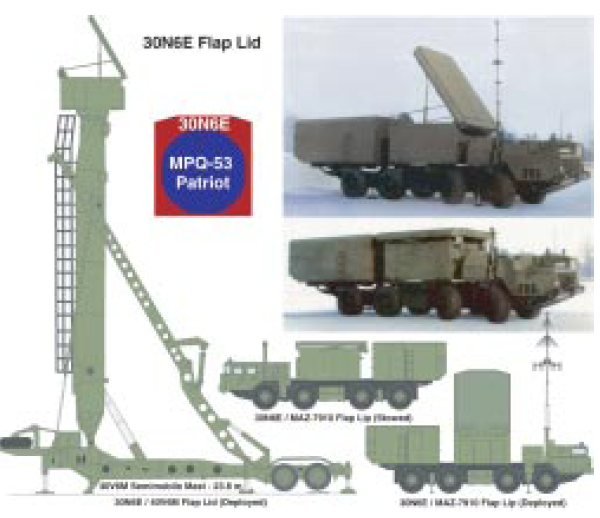
The first generation of the S-300P’s 30N6 Flap Lid A engagement/ fire control radar was also innovative, and clearly influenced by the Raytheon MPQ-53 engagement radar for the MIM-104 Patriot. The Flap Lid, like the MPQ-53, uses a transmissive passive shifter technology phased array, with a space (aka optical) feed
into the rear plane of the antenna, using a microwave lens rather than a horn feed.

The Flap Lid’s antenna stows flat on the roof of the radar cabin, which was initially deployed on a trailer towed by a Ural-357, KrAZ-255 or KrAZ-260 6x6 tractor. The whole radar cabin is mounted on a turntable and used to slew the phased array to cover a 60 degree sector of interest.

 The 30N6 was a huge generational leap in technology from the Fan Song, Low Blow and Square Pair mechanically steered and scanned engagement radars on preceding V-PVO SAMs. With electronic beam steering, very low sidelobes and a narrow pencil beam mainlobe, the 30N6 phased array is more difficult to detect and track by an aircraft’s warning receiver when not directly painted by the radar, and vastly more difficult to jam. While it may have detectable backlobes, these are likely to be hard to detect from the forward sector of the radar. As most anti-radiation missiles rely on sidelobes to home in, the choice of engagement geometry is critical in attempting to kill a Flap Lid.

The first generation of the 5V55K missile was command link guided, following the design philosophy of
the S-75/SA-2 and S-125/SA-3, with a cited range of 25nm (46km) and altitude limits between 80ft and 80,000ft.  This variant was designated the S-300PT (P – PVO, T –Transportiruyemiy) and incrementally upgraded models the S-300PT-1, it entered service in 1978. NATO labelled it the SA-10A Grumble.

Two search and acquisition radars were introduced to support the S-300PT, both with 360 degree coverage. The 3D 36D6/ST-68UM/5N59 Tin Shield was used for high and medium altitude targets, and the 2D 76N6 Clam Shell for low altitude low RCS targets (refer AA 10/95 for detailed analysis). An important feature of the S-300PT was the introduction of the semi-mobile 40V6, 40V6M and 40V6MD masts, towed by a MAZ-543 derived tractor, in turn based on the 1966 Scud launcher vehicle.

The 23.8 metre tall 40V6, 40V6M could be used to elevate the Clam Shell, Tin Shield and Flap Lid radars to extend their radar horizon and improve clearance in uneven terrain. The ‘double height’ 37.8 metre tall 40V6MD appears to have only been used with the Clam Shell and its recent 96L6 replacement. The masts take one to two hours to erect.

The unique 40V6 series masts permit static or semi-mobile S-300P series SAM systems extended low level coverage not available in any competing western designs, and were clearly introduced to defeat SAC’s low level FB-111A, B-52G/H and B-1B force – and the AGM-86B cruise missile. These masts continue to be marketed as an accessory for the latest production variants of S-300P radars.

The 36D6 Tin Shield is semi-mobile and towed by a KrAZ-255 or -260 tractor, it can be deployed or stowed in one hour, or two with the mast. The design uses a large paraboloid cylindrical section primary reflector and a linear element array deployed on a pair of booms to provide electronic beam steering in elevation from -20 to +30 degrees, the antenna can perform a full 360 degree sweep in five to 10 seconds.
With a transmitter peak power rating cited between 1.23 MegaWatts and 350 kiloWatts, the manufacturer claims the ability to detect a 0.1 square metre RCS target at 300ft AGL out to 24.8nm (46km), and at medium to high altitudes to 94.5nm (175km). Clutter rejection is claimed to exceed 48 dB, and the system can track 100 targets. An IFF system is integrated in the radar.

The S-300P series systems have seen several generations of progressively more capable TELs deployed.
The semi-mobile SA-10A 5P85PT TELs were supplanted by road mobile 5P85TE series TELs which remain an             option even for the latest export models. The offroad mobile 5P85D/S series TELs arrived with the SA-10B/C and are
used by the PLA, with more recent SA-10D/E and S-400 systems using the improved 5P85SE
TELs – all are derived from the original MAZ-543 Scud launcher vehicle

RUSSIA DEVELOP THE ALMAZ S-300P/SA-10 SAM SERIES

The earliest origins of the S-300P series lie in the mid 1960s, when the Soviet Voyska PVO and Ministry of Military Production initiated its development. The aim was to produce an area defence SAM system capable of replacing the largely ineffective S-75/SA-2 Guideline and S-200/SA-5 Gammon systems, neither of which performed well against low flying Wild Weasels, low RCS targets or US support jamming aircraft.

The original intent was to design a common SAM system for the Voyska-PVO (Air Defence Forces), Voenno-Morskiy Flot (Navy) and the PVO-SV (Air Defence Corps of the Red Army), but divergent service needs across these three users soon saw commonality drop well below 50%. Ultimately the V-PVO’s S-300P series and PVO-SV’s S-300V series diverged so completely to become largely unique systems.

 The design aims of the original S-300P were to produce a ‘strategic’ area defence SAM system, intended to protect fixed targets such as government precincts, industrial facilities, command posts and headquarters, military bases, strategic and tactical airfields and nuclear sites.

This weapon system was to initially defeat SAC’s SRAM firing FB-111As, B-52Hs and then anticipated B-1As, and later the Boeing AGM-86B Air Launched Cruise Missile. The deployment model of the first generation systems was based on the existing S-75/SA-2, S-125/SA-3 and S-200/SA-5 systems, with a semi mobile package of towed trailer mounted radars and missile Transporter Erector Launchers (TELs).

The S-300P introduced some important technological innovations. The first generation V-500/5V55 missile used a single stage solid rocket motor, and conceptually is closest to the baseline US Army MIM-104 Patriot. The missile was deployed and handled in a sealed cylindrical launch tube/canister, with a ‘cold start’ gas generator used to eject the missile vertically before its motor was initiated.

The 5P85 TEL was a semitrailer arrangement, with the forward booms splayed when deployed as stabilisers. The four launch tubes were mounted on a hydraulically elevated frame, retained in later TEL designs. A typical battery would be equipped with three 5P85 TELs, each with four SAMs, or double the SAM complement of the S-75/SA-2 it replaced and permitting two rounds per launch.

Wednesday, November 17, 2010

Russia Defense S-300P And S-300V Next Generation Ballistic Missile System

S-300P/S 400 and S-300V Missile System

The Almaz S-300P/S-400 (SA-10, SA-20) and Antey S-300V (SA-12) SAM systems are excellent examples, the former widely acknowledged to be ‘Russia’s Patriot’ and the latter having no direct equivalents in the west, but some similarities to Israel’s Arrow Anti-Ballistic Missile system. Both of these systems grew out of the disappointments of Vietnam and the Yom Kippur war, where ‘single digit’ S-75/SA-2, S-125/SA-3 and 3M9/SA-6 series SAMs were soundly defeated in combat by the US and Israelis respectively. Designed for the high density battlespace of late Cold War central Europe, the S-300P and S-300V series of SAMs represent the pinnacle of Soviet Cold War era SAM technology, with no effort spared to push the technological envelope.
S-300V Missile

The S-300P Missile series and S-300V Missile would have required unusually intense defence suppression efforts, changing the character and duration of both air campaigns. The political fracas surrounding the Cypriot order for S-300PMU1, and the long standing intent of both North Korea and Iran to purchase large numbers of late model S-300Ps underscore this point.

In US terminology, the ‘double digit’ S-300P Missile series and S-300V Missile systems represent ‘anti-access capabilities’ – designed to make it unusually difficult if not impossible to project air power into defended airspace. The B-2A Spirit and F/A-22A Raptor were both developed with these threat systems in mind, and are still considered to be the only US systems capable of robustly defeating these weapons. The technique for defeating them is a combination of wideband all aspect stealth and highly sensitive radio frequency ESM receivers, combined with offboard sources of near realtime Intelligence Surveillance Reconnaissance
(ISR) data on system locations.

Aircraft with no stealth, reduced RCS capabilities, or limited aspect stealth, such as the F-15E, F-16C, F/A-18E/F, Eurofighter Typhoon and F-35 JSF are all presented with the reality that high to medium altitude penetration incurs a very high risk of engagement by either of these weapon systems.

That the DoD leadership have opted to wholly ignore the arrival of the S-300P/S-300V series SAMs in their long term force structure planning is nothing less than remarkable and raises some very serious questions about how well the capabilities of these systems are understood in the halls of Russell Offices. Despite repeated proposals by a great many parties, there are no plans to equip the RAAF with anti-radiation missiles or support jamming aircraft, persistent lobbying for F-111 retirement, and the F/A-22A Raptor, the US solution to the S-300P/S-300V Missile problem, is generally dismissed as being “too good for Australia”.

 The S-300P/S-300V series SAMs were designed for austere support environments, to be operated and maintained largely by Soviet era conscripts. Therefore the integration of these weapons into wider and nearer regional force structures will not incur the delays and difficulties expected by some observers with the Sukhois.

A package of S-300P/S-300V batteries could be operationally viable within months of deployment in the region, and earlier if contract Russian or Ukrainian personnel are hired to bring them online faster. The notion of ‘15 years warning time’ looks a little absurd, given that these systems can proliferate and operationally mature as capabilities within one to two years.

S-300P Missile

Thursday, October 14, 2010

Russian The Best S-330 Missile Defense and Sale

This show went live at Russia Today satellite TV channel 09/22/2010 (New rillies)

Igor Khokhlov from the Moscow-based Institute of World Economy and International Relations claimed that Russian officials have always been very prudent and have always followed the international line.

"Actually Russian officials announced from the very beginning, right after the sanctions were imposed, three months ago in June, that Russia is going to follow all international regulations and international law and if this system, S-300, falls under the sanctions, it means it will not be shipped to Iran before the situation changes," Khoklov recalled. "Russian Prime Minister Vladimir Putin said it right after the sanctions were imposed." As for the Russia's plans to increase military co-operation with Israel, there is nothing especially interesting about it, Khokhlov said.

"There are a lot of speculations about vested interests of Israeli lobby or Iranian lobby in Russia," he told RT. "Actually Russia has been co-operating with over 100 countries selling its military gear and now Russia is going to sell its military gear to Afghanistan, Russia is doing business with Saudi Arabia. Russia has lots of multi-million contracts with Israel. Russian and Israeli companies develop military hardware and sell it then to India. [The] Russian military industrial complex is so large, it has links to almost all countries all over the world, and I think it's quite unreasonable to have any vested interests."

Russian Military Best Weaopons Parade

Waeopons Parade Russian Defense Military.
The Russian military is divided into the following branches: Ground Forces, Navy, and Air Force. There are also three independent arms of service : Strategic Missile Troops, Military Space Forces, and the Airborne Troops.

Russia possesses the largest stockpile of nuclear weapons in the world. Russia's Strategic Rocket Forces controls its land-based nuclear warheads, while the Navy controls the submarine based missiles and the Air Force the air based warheads. Russia's nuclear warheads are deployed in four areas:

1. Land based immobile (silos), like RS-24.
2. Land-based mobile, like SS-27 Topol M.
3. Submarine based, like SS-N-30 Bulava.
4. Air-based warheads of the Russian Air Forces' strategic bomber force
5. The Navy consists of four fleets:

*Baltic Fleet (HQ at Baltiysk in the enclave of Kaliningrad Oblast).
*Pacific Fleet (HQ at Vladivostok).
*Northern Fleet (HQ at Severomorsk).
*Black Sea Fleet (HQ at Sevastopol, Ukraine. (In 2005, the Ukrainian government agreed that Russia would be allowed to lease several base areas around Sevastopol until 2017.)
*Armed Forces of the Russian Federation

Military manpower (Source mostly CIA World Factbook)
Military age 18 years of age Availability males age 18-49: 35,247,049 (2005 est.). Fit for military service males age 18-49: 21,000,000 (2006 est.). Reaching military age annually 821,103 (2008 est.). Active troops 1,037,000 Total troops 3,796,100 Military expenditures $34 billion USD.

 
content="KxPS6GPOk1jXixOC5uWVt4sKw8A" />