Showing posts with label Artillerys. Show all posts

Friday, June 10, 2011

ROMANIA JOINED SERBIA AND U.K PRODUCE ARTILLERY

English/UK made M777 ARTILERRY

In pursuit of the UK’s now defunct Lightweight Mobile Artillery Weapon System (Gun) programme, BAE systems developed a system based around the M777 and carried by a portee 8x6 SUPACAT vehicle
weighing in at 12.3 tonnes. Rather than being fired from the Supacat, the standard ‘towed’ gun would be ‘dropped off’ and could be fired in under three minutes.

Denel Land Systems’ iconic 6x6 G6 platform is in service with South Africa, UAE and Oman and has demonstrated a road range of 700km while its L45 ordnance can reach ranges of as high as 53Km and can deploy and pull out in one minute and thirty seconds. A L52 variant with a new turret design, the G6- 52 has been developed but has yet to find a customer. The same ordnance is used in the T5 8x8 truck mounted system.

South Africa’s Denel Land Systems has had much success with the performance of the 105 mm Light Experimental Ordnance (LEO), described as meeting or exceeding the range – over 30km - and effectiveness of 155mm/39 calibre rounds, with a reduction in weight by over 40 percent. US firm General Dynamics Land Systems, integrated the LEO on a Stryker chassis for trials but these subsequently lapsed. A truck mounted
version has also been developed.


Serbia Made NORA B-52

Other eastern European players in the truck mounted arena include Serbia which is reported to have sold a 155 mm/52-calibre KamAZ-mounted variant of the NORA B-52 SP howitzer. Slovakia’s Zuzana howitzer is a 155mm/L52 version of the turreted 8x8 Dana howitzer.

ATROM Aerostar Wheeled self-propelled howitzer Made Roman

The system has been acquired by the Israel Defence Forces and several other undisclosed countries. Soltam have also been reported to have delivered a D30 122mm ATMOS based solution for Kazakhstan. Working
with domestic firm Aerostar in Romania, Soltam have developed the ATROM which takes the ATMOS gun and matched it with the locally made Roman 26.360 DFAEG 6x6 truck.


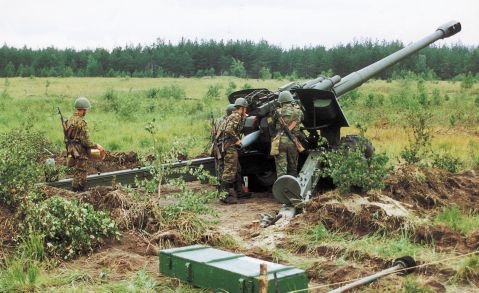

Russia Made 2A65 Msta-B towed howitzer Artillery

152mm 2A65 Msta-B towed howitzer is designed to engage hostile exposed and sheltered manpower, weapons, tactical nuclear weapons, command and control posts, artillery and mortar batteries, tanks and
infantry in strongholds, at deployment lines and on march, AD and EW assets, etc., as well as to demolish field fortifications.

Depending on the mission at hand, howitzer fires regular or HE-fragmentation rocket-assisted ammunition including cluster munitions filled with fragmentation, HEAT-fragmentation, or self-targeting submunitions, illuminating and smoke rounds, active tactical communications jamming rounds and Krasnopol laser beam riding precision-guided projectiles. Unlike other artillery systems, 2A65 howitzer can fire ammunition organic to ‘legacy’ pieces, e.g.


152mm D-20 gun-howitzer. The weapon is mounted on a twotrail carriage provided with a firing platform. When trails are being split, the wheels’ springing automatically cuts off, which in combination with the three-baffle muzzle brake makes the howitzer very stable at firing. Msta-B has an elevation of 70 degrees, with traverse equalling 28 degrees to the left and 27 degrees to the right. Laying is performed via a two-speed laying mechanism.

The howitzer features separate loading which at any elevation is performed by the spring-operated projectile and propellant charge rammers cocked by the weapon’s recoiling parts in the course of firing. There is
a loading tray to prevent round’s components from falling down. The tray is set into position automatically whenever the wedge-type breech mechanism is open. When in travelling configuration, Msta-B
howitzer is towed by Ural-4320 or KamAZ-43118 truck.

2A65 Msta-B towed howitzer Artillery

Friday, January 28, 2011

Italian Produce Model 56 Artillery By Otobreda

The 105 mm barrel assembly of the Model 56 Pack Howitzer is composed of the barrel, breech ring, slipper and muzzle brake. The weapon has a multibaffle muzzle brake. The vertical sliding breech block has a percussion firing mechanism which can be cocked automatically or by hand. Firing is either by hand lever or by lanyard.The gun carriage comprises the undercarriage, saddle, cradle, upper and lower recoil systems, two balancing springs, two sights and the shield.


The undercarriage consists of a cross head housing the saddle centre pivot pin, two stub-axles, spring equalising rocker arm and two articulated arms. Each of the stub-axle supporting arms has two bearings into which the stub-axle can be fitted, this carries the wheel assembly and its handbrake. Each of the articulating brackets carries a trail leg of two or three sections, which can be folded up and interlocked. The end section of the trail may be anchored to the ground by a knife or rock spade.

The capability of this weapon to be "knocked-down" allows the sections to be transported a number of ways although the original design was for mule-pack using special pack saddles. More usually it is towed by a light vehicle such as a jeep or Land Rover, and with the shield removed it can be carried inside a M113 APC. However, its particular attraction to Western Armies in the 1960s was its light weight meant it could be lifted in one piece by helicopter.

This made the gun popular with light artillery units in many countries as well as the more specialised Mountain and Airborne troops. Over all, the Mod 56 has served in more than 30 countries worldwide, of which a partial listing of the major operators is listed below. It can be used either as an artillery gun using indirect fire ballistic trajectory or as anti-tank weapon using line-of-sight fire. OTO Melara designed this gun to be fully compatible with the charges and projectiles employed on the US Army M101 105mm howitzer.

Franch LG1 Mark II Howitzer Artillery By Giat Technologies Military Industries

The 105mm LG1 Mk II has a cannon assembly with a semi-automatic breech, a vertical breech block and a muzzle brake. It has a twin trail, welded top carriage and a recoil mechanism whose variable recoil enables firing without a recoil pit. The trails are coupled to the moving parts through a suspension mechanism so that, with the trails closed, the wheels are in contact with the ground (towing position) and, with the trails open, the wheels are lifted and the platform is in contact with the ground (firing position).The gun can be operated with a crew of five or seven, If necessary, deployment can be performed with a crew of three.

The LG1 Mark II howitzer is a 105 mm towed artillery piece that features both low weight and a high level of accuracy over long distances. Its lightweight construction gives the barrel a relatively short lifespan. The EFC count is suggested to be approximately 7,500; however, during fire and practice, has yielded only around 1,500 EFCs. The gun was specifically designed for use by rapid deployment forces with attributes such as ruggedness, ease of operation and reduced weight. It can fire all NATO standard 105 mm ammunition up to a range of 18.5 and 19.5 kilometres (11.5 and 12.1 mi) using HE-ER G2 and US M913 rounds.


Specifications:
Length: 6.7 m
Width: 4.1m
Height: about 3 m
Weight: 1.5 ton
Elevation: -84 to 1270 mils
Range of weapon: 18 km (full traverse capability)
Ammunition: 34 rounds on board storage
Engine: 8-cylinder diesel
Maximum speed: 490m/s
Range of operation: 355 km on road
Number in Service: 28

South African LIW 150 mm Light Experimental Ordnance Leo Howitzer Artillery By Denel

The 105 mm Light Experimental Ordnance has a split trail carriage of high-strength steel and when deployed in the firing position is supported by a jack lowered under the forward part of the carriage and by the spade on the end of each trail.The carriage is provided with an adjustable towing hook for towing by 4 × 4 vehicles and lifting hooks for transportation slung under a helicopter.The 105 mm autofrettaged ordnance is 52 calibres long, or 57 calibres when fitted with the advanced muzzle brake, and has a rifling twist of 1:22.

The high efficiency pepperpot muzzle brake has special Laval-shaped nozzles and is rifled on the inside, which effectively adds five calibres to the barrel.The ordnance has a fixed recoil length of 1 m with a gas type counter system being fitted. Counter recoil is also used to retract the 105 mm ordnance using the hydraulics of the traverse and elevation system.The breech mechanism is of the semi-automatic swing and slide type.

Denel Land Systems stress that this is a technology demonstrator and is not representative of a type classified and ready for production 105 mm artillery system. If adopted for service it will probably be given the designation of the GV7 or G7 for international marketing purposes. Its primary role is close support. According to Denel Land Systems, there is no other artillery system in the world with the capabilities of the 105 mm Light Experimental Weapon which includes a maximum range of 30,000 m.

This is similar to that of 155 mm/39 calibre artillery systems with the new 105 mm high-explosive artillery projectile, having a lethal area of 1,900 m2 against targets. This is claimed to be better than a first-generation 155 mm artillery projectile.A 105 mm Light Experimental Weapon together with 100 rounds of 105 mm ammunition currently weighs

Thursday, January 27, 2011

Fh-77 BD 155mm Howitzer Towed Artilerry Swedish

The Fh-77 BD is a further development of the prototype system, which mounts the elevating mechanism of the earlier version, Fh-77B 155 mm towed artillery system on a commercial 6X6 articulated all-terrain chassis. This was originally developed as a private venture but was subsequently funded by the Swedish Defence Material Administration with two versions developed and tested by the Swedish Artillery School.


In March 2000 it was reported that the latest version of 155 mm Bofors guns would be sent to India for extensive field trials on “no-cost, no-commitment” basis in May 2000s. The Indian defence ministry accepted Bofors Weapons Systems’ offer to send the 45-calibre FH-77 BD, the towed version of which is already in use with the Indian army, for trials. India invited a number of companies to demonstrate their 155 mm artillery systems in a bid to finalise its choice to meet the army’s requirement of about 200 more field howitzers. The FH-77 BD 6x6 self-propelled artillery system and French Giat Industries Caesar 6x6 155mm 52-calibre systems are seen as possible alternatives to the towed weapon systems. Compared with conventional full-tracked self-propelled artillery systems, these weapons would be cheaper to procure and maintain and offer greater strategic mobility.

In early October 2001 it was reported that the Indian government wanted to buy around 3,000 additional FH-77 howitzers. A self-propelled artillery competition -- pitting the Celsius (Bofors) FH-77AD against the Denel LIW T-6  is underway as part of its Field Artillery Rationalization Plan. The main advantages that the Celsius FH-77AD offers over the Denel T-6 is that it is based on a proven and easy to maintain 6X6 Volvo truck chassis. The Arjun tank chassis to be used by the Denel T-6, in contrast, has yet to enter full service.
The FH 77B is able to fire 8 rounds and move 500 m away taking less than 3 minutes. It is also able to fire 3 rounds within 3 minutes and sustain a rate of fire of 8 rounds/minute. The system is provided with its own navigation system to achieve optimized accuracy performing multi-round simultaneous impact. The gun crew is transported in an armored cabin and the ammunition boxes have the same degree of protection of the as the crew compartment. A single FH 77BD carries 24 rounds and 42 charges.

The FH77 B is now integrated with a 6x6 all-terrain vehicle making it an extremely powerful, highly mobile artillery system. It's into-action time is less than 50 s. An artillery sequence: into action; fire 8 rounds; out of action and move 500 m takes less than 3 minutes. The gun has a range of 30 km, it can fire 3 rounds within 13 s and a has sustained rate of fire of 8 rounds/minute. On the move the gun crew is transported in an armoured cabin. The on-mount ammunition boxes, in effect magazines, have the same level of protection as the crew compartment. The FH77 B has its own land navigation system, eliminating surveying and alignment and the complete system has very low LCC.

South Africa Made High Technology G6 155mm Self Propelled Howitzer Artillery By Denel

The G6 is fully compatible with NATO standard 155-mm ammunition and has a direct fire range of 3000 meters (using a Frag-HE round). Used together with the specially developed modular charge ammunition system, the 45-calibre gun provides accurate coverage of a target zone of more than 1000 square kilometres, without change of position. 45 rounds are carried on board. The onboard gyro-controlled navigation and automatic laying systems enable the gun to be brought into action independently within 60 seconds of stopping and it can move off 30 seconds after firing, thus presenting an elusive target.

Their accurate G6 155mm howitzers continue to outrange all competitors, and the base-bleed ammunition technology they pioneered has become a widespread option for countries looking to extend the range of their existing artillery systems. Industrial partnerships with Rheinmetall and Diehl BGT Defence of Germany have led to orders to supply Germany’s 155mm howitzer and 120mm mortar ammunition, and partnerships have also been explored with General Dynamics in the USA.

The G6 is fully compatible with NATO standard 155-mm ammunition and has a direct fire range of 3000 meters (using a Frag-HE round). Used together with the specially developed modular charge ammunition system, the 45-calibre gun provides accurate coverage of a target zone of more than 1000 square kilometres, without change of position. 45 rounds are carried on board. The onboard gyro-controlled navigation and automatic laying systems enable the gun to be brought into action independently within 60 seconds of stopping and it can move off 30 seconds after firing, thus presenting an elusive target. The G6 is equipped with an electronically controlled hydraulic flick rammer that provides an initial rate of fire of 3 rounds per minute.

Wednesday, January 26, 2011

Singapura Made LWSPH

LWSPH


The LWSPH was certified for air-transportation by C-130 aircraft, CH-53 and CH-47 helicopters.
The LWSPH has a maximum speed of 80 km/h, cruising range of 600 km and a slope-climbing capability of 60%. It is also designed for unparalleled battlefield survivability with its ability to shoot and scoot. A quick dash across 500 m takes less than a minute. Emplacement and displacement, which requires only three men, also takes less than a minute.


The LWSPH program, a 7 ton system utilizing a 39 Cal 155 gun mounted on a light, air transportable chassis which can be delivered by C-130 aircraft and heavy lift helicopters. The system is powered by a turbocharged intercooled diesel engine, and mounted on a lightweight chassis for rapid deployment. The gun can utilize standard projectiles to a range of 19km or extended range ERFB munitions firing 2 - 6 rounds per minute to a maximum range of up to 30km.

LWSPH

Thursday, January 20, 2011

Smerch-M BM 9K58 And BM-30 Smerch 9A52 Multiple Launch Rocket System Russia Technology

The 48.5 ton Smerch version the Indian Army is acquiring is capable of firing six types of rockets to a maximum range of 90 km. This is approximately 60 km further than regional rival Pakistan’s M109 self-propelled howitzers can fire. In addition, several of its rocket types have submunitions warheads that can cover wide areas with anti-armor or fragmentation munitions, neutralizing concentrations of armor and troops well beyond the range of any of India’s present artillery systems. The 9M55C rocket even packs a 500-pound thermobaric (fuel-air explosive) warhead.

Novosti Press Agency notes that with the signing of the contract, India will become the third foreign country to receive the Smerch MLRS. Russia delivered 18 systems to Algeria in 1999, and 27 systems to Kuwait in 1995-1996.


Defence Ministry sources said that the Smerch contract was divided into 3 stages over 3 years, with deliveries scheduled to begin later this year with the arrival of launchers and ‘basic’ rockets. More advanced version launchers and the guided rockets would arrive in subsequent stages, with deliveries to be completed some time in early 2008.

Smerch 9K58 launch vehicle is able to fire single rockets, or salvo from some to all 12 rockets. Full salvo lasts 38 seconds. Projectiles are launched by operator from inside the cabin or outside it, using extractive control device. Three "Smerch" launching vehicles salvo destruction power is equal to the work of two brigades, fitted with 9K79 "Tochka-U" ground-to-ground missiles. One launching vehicles salvo covers square of 672 square meters in 20 - 70 km range.

High "Smerch" MLRS combat electivity is ensured by usage of "Vivariy" half-automatic fire control system. Fire control system was developed and is produced by Tomsk city "Kontur" production association. This fire control system joins some command vehicles placed under MLRS brigade commander's dis"Smerch" launches 300-mm rocketposition and also lower level commanders (up to three) and MLRS batteries (up to 18). Every of such vehicles are based on "KamAZ-4310" trucks. It has computer, display, printing device, communication sources and scrambler equipment.
BM-30 Smerch 9A52
Vehicles have autonomic electricity systems moving and in position. "Vivary" system command staff vehicles provide informational interchanging between upper level commanders and MLRS crews. It plans artillery fire concentration and fire into moving enemy lines tasks, prepares data for firing, gathers and analyzes information on artillery subdivisions. In it's efficiency "Vivariy" fire control system is equal to USA analogue "Takefire".

The BM-30 Smerch 9A52 is a russian made heavy multiple rocket launcher. The BM-30 is designed and manufactured by the Russian Company Splav State Research and Production Association, Tula, Russia, which also manufactures the Uragan, Grad and Prima rocket launchers. The BM-3 Smerch 9A52 wast first seen by the West in 1983, and it entered in the Russian army in 1987. The BM-30 Smerch 9K58 is designed to counter tactical missile systems, army aviation at staging airstrips, as well as rocket, artillery and mortar battalions and batteries, command post, and manpower concentration areas. A Smerch unit is typically composed of six launchers and six transloaders. Now it is used by Russian, Ukraine, Belarus, Kuwait, and United Arab Emirates, Indian and Chinese armed forces.

Tuesday, January 18, 2011

Bantam ATGM and MBT LAW Made Swedish

Bantam ATGM

The Bantam ATGM is an old, first-generation ATGM that was one of the first successful ATGM ever produced. It is a small and lightweight missile that, when first designed, was used primarily by Swedish and Swiss forces, with some limited use by British, Norwegian, Danish, and US forces. As the Bantam initially got little combat use, but was produced in large numbers, they became popular "hand-me-down" weapons for client states of US and NATO countries.


By 2000, the Bantam is found mostly in the Third World, and mostly in the poorer Third World countries at that. Bantam is fired from a box launcher, connected by wire to a control unit. The control unit may be directly connected to three launch boxes, and a distribution box may be added to allow the gunner to control up to 18 launch boxes. (Only one missile may be guided at a time, however.) The gunner may position himself up to 120 meters from the missiles. The Bantam has a maximum range of 2000 meters; at this point, the missile runs out of wire, and it automatically self-destructs by detonating the warhead.

MBT LAW
This is a light ATGM fielded by the Swedish in early 1998, and is now being used in growing numbers by the British, Dutch, and Norwegians. The MBT LAW combines features from the M-136 antitank rocket and the Bill-2 ATGM. The system uses a soft launch feature that kicks the missile clear of the launch tube before igniting the rocket motor.


This allows the MBT LAW to be fired from confined spaces as well as minimizing launch signature. It may be employed as both an antiarmor weapon and as a bunker buster; for bunker busting, the weapon is fired without its top-attack capability, and penetrates the target before detonating the main warhead. The weapon is disposable, and can use a night sight if desired.

 
content="KxPS6GPOk1jXixOC5uWVt4sKw8A" />