Showing posts with label Assault Rifle. Show all posts

Tuesday, June 5, 2012

XM2010 Sniper Rifle U.S Army

The 300 Winchester Magnum is a well established cartridge in the US arsenal. Recent modernization initiatives focused around rifles and ammunition are advancing the effectiveness of this proven cartridge. This XM2010 sniper rifle Employment Zone (WEZ) analysis is intended to quantify how the hit percentage of the 300 Winchester Magnum is improved thru these modernization efforts. Primarily the ballistic performance of various ammunition types will be evaluated. As part of the 300 Winchester Magnum modernization, rifles have been upgraded and ammunition improvements are being considered XM2010 sniper rifle. This WEZ analysis will focus on the existing ammo types being considered, as well as some additional variations allowing for newer bullet options that have not been included in any systematic analysis to date.

For purposes of this analysis, the muzzle velocities from the 24" barreled (suppressed) XM-2010 will be considered most relevant, and therefore used for all calculations. The A191 (MK248 Mod0) and Mod 1 rounds are fairly well known and have often been compared against each other. For purposes of the present analysis, an additional ammo type is proposed for comparison, namely 230 OTM. This proposed round will be considered in relation to the other familiar ammo types in several environments to see how the hit percentages compare.


 It's clear from the dimensioned drawings that the 190 and 220 grain SMK's are very similar bullets, with the only major difference being the length of the bearing surface. The relatively blunt nose results in G7 form factors of around 1.06 for both of the SMK's. By stark contrast, the Berger 230 grain OTM has a much longer nose with a tighter meplat diameter and a optimal 7 degree boat tail. The G7 form factor of the Berger Hybrid OTM is 0.91, which indicates 15% less drag than the SMK design. This 15% drag reduction, in addition to being heavier than both of the SMK's results in the Berger Hybrid OTM having a dramatically higher Ballistic Coefficient (BC) and better ballistic performance. All of the bullets under consideration are fully stable when fired from 1:10" twist barrels.

In order to conduct a complete WEZ analysis, the 3 bullet options will each be evaluated for hit percentage in various uncertainty environments. The intent of the different uncertainty environments is to determine how hit percentage is affected in relation to the variables commonly encountered in real world shooting. Atmospheric conditions will be modeled as ICAO standard sea level values1. Other uncertainties will be modeled in 3 confidence sets; high, medium and low.

The high confidence uncertainty set is intended to model a highly trained shooter with a laser rangefinder, 1/2 MOA rifle, and ammunition loaded with 10 fps Standard Deviation (SD) in muzzle velocity. The medium confidence uncertainty set models a nominal shooter with an average ability to estimate wind speed, compromised use of laser rangefinder, average 1 MOA rifle with typical ammunition having 15 fps SD. Finally the low confidence uncertainty set represents poor wind estimation, MIL'ing targets for range, and below average rifle and ammunition. Detailed plots and tables of the hit percentage results for each uncertainty environment can be found in the Appendix.


Of course any calculated hit percentage depends greatly on the size and shape of the target. The target that's modeled for this analysis is the standard IPSC silhouette target shown in Figure 2. Trajectories that intersect the target area are considered hits, those that don't are misses. There is no consideration made for where the bullet strikes the target. The benchmark Kinetic Energy (KE) indicated on the plots is 1000 Ft-lb. The importance of this metric is debatable, but it's shown on the plots as a reference for comparison. The benchmark Transonic (TS) speed is Mach 1.2, which equates to 1339 fps in ICAO standard conditions. The transonic speed is indicated on the WEZ plots with a TS, and all values in the hit percentage tables that correspond to velocities lower than transonic are printed in gray.

The first element of the results analysis will be retained velocity for the 3 ammo types. Figure 3 shows a plot of velocity traces from muzzle to 1500 meters with numeric table values at; muzzle, 500 meters, 1000 meters, and 1500 meters. Since A191 sniper rifle is the lightest bullet, it starts out with the highest velocity. However the heavier 220 and 230 grain bullets quickly catch and surpass the 190 grain bullet in retained velocity. It only takes 162 meters for the 230 bullet to match the retained velocity (2585 fps) of the 220 grain bullet. The 220 grain bullet meets the 190 at 372 meters with a retained velocity of 2260 fps. At 262 meters, the 230 surpasses the 190 grain bullet in retained velocity (2456 fps). In summary, beyond 262 meters, the 230 grain OTM retains more velocity than both the A191 Rifle and MK248 Mod1 Rifle.

Retained velocity is an indicator of how flat a trajectory is. Flatness of a trajectory is related to danger space. Therefore we can say the 230 OTM has the greatest danger space on any sized target beyond 262 meters if all rounds are zeroed at the same range. In addition to relative retained velocity, it's also interesting to look at where the transonic zone falls for the three ammo types. The WEZ analysis uses Mach 1.2 (1339 fps) as a common transonic speed.

However, it can be difficult to predict the exact velocity at which transonic stability effects begin. Figure 3 indicates the zone between Mach 1.2 and Mach 1.0. This is the zone in which one can reasonably expect the onset of transonic instability effects in a sea level environment. Figure 4 shows the ranges that correspond to the upper transonic speed zone (1339 fps to 1116 fps) for each ammo type. It's clear that the 230 OTM pushes the transonic zone much farther than either A191 or MK248 Mod1.

Note that the specific levels of retained velocity are highly subject to atmospheric conditions. The above results are all for ICAO standard sea level conditions. In environments higher above sea level, the bullets will retain velocity much better and the ranges corresponding to transonic zones can be dramatically pushed out. For example, in a density altitude (DA) of 5000 feet, the range at which the 230 OTM encounters Mach 1.2 is extended from 1285 meters to beyond 1500 meters. In other words, the 230 OTM can remain comfortably supersonic to beyond 1500 meters at DA's of 5000 feet and higher. Ranges corresponding to Mach 1.2 for A191 is increased from 982 to 1150 meters, and for MK248 Mod1, Mach 1.2 is extended from 1079 meters to 1260 meters.
If the differences in retained velocity appear dramatic, one only needs to refer to Figure 1 which shows the 3 different bullets under consideration. The dramatic difference in bullet design is directly responsible for the dramatic difference in BC and retained velocity.

Wednesday, April 4, 2012

Armalite AR-30M High Accuracy Target

I evaluated the performance of SRT’s .338 suppressor on an ArmaLite AR-30M rifle. In my experience, the AR-30M is the best value among .338 rifles today. Better factory and custom rifles are available, but they cost more. Several cost ten times more. It is noteworthy for its accuracy, superb muzzle brake, detachable box magazine, and bang for the buck.


The ArmaLite AR-30M sniper rifle consists of two sub-systems: the barreled action and stock assembly. The two sub-assemblies are mated via a robust V-block channel in the aluminum forestock that provides an accurate, repeatable, and robust interface with the rifle’s rather unusual octagonal action. The detachable box magazine is a single-stack design that minimizes the size of the opening in the receiver, which maximizes the rigidity of the action and thereby the accuracy potential of the rifle. The butt stock assembly can be removed for transport or storage.


The AR-30M’s  is superb in terms of engineering and cost-effectiveness. It provides a much more comfortable and natural shooter interface compared to the most widely used milspec .338 stock. SRT’s SHADOW suppressor drops the .338’s blast overpressure to that of a .22LR rifle with standard velocity ammo. Environmental disturbance becomes a matter of inches rather than half the length of a football field. Blast overpressure becomes a non-issue for shooting enthusiasts. One can even shoot this big boomer comfortably without hearing protection. These qualities are also invaluable to the armed professional. A sniper’s spotter can tuck in tight behind the shooter near the bore axis to maximize his value. The sniper can see his hit and place his next shot more quickly. And the astonishing reduction of sonic and visual signatures makes the sniper and spotter invisible, assuming proper fieldcraft.


What about accuracy? Most folks I know who own ArmaLite’s .338 rifles generally achieve 1/3 to ½-MOA groups. That is extraordinary performance in a rifle with an entry-level price tag. A few shooters achieve even better accuracy using handloads tailored to their specific rifle. The bottom line is that everyone I know gets better than 1-MOA, so every ArmaLite .338 rifle that I know about delivers sniper-grade accuracy. Sound suppressors generally improve rifle accuracy, but maintaining accuracy, much less improving it, becomes very difficult when suppressing cartridges of large caliber such as the .338 Lapua Magnum and above. Moreover, unusually small suppressors for a given caliber are more likely to have accuracy issues than large suppressors of the same caliber.


While the AZTECH baffle movesgases at a time and a place where cross jets and turbulence are not likely to destabilize the bullet, the .338 SHADOW must manage nearly twice the gas volume of the .308 SHADOW, using the same number of baffles and only 20% more volume. I was mindful of this challenge every time I headed to the range to put the SRT Arms .338 SHADOW through its paces. I evaluated SRT’s .338 SHADOW sound suppressor and ArmaLite’s AR- 30 rifle using Black Hills .338 Lapua Magnum ammunition. If a barrel’s twist rate is suitable, I prefer the .338 variant that features a 300-grain Sierra MatchKing HPBT bullet. Since the hollowpoint is an artifact of the manufacturing process, rather than a design element intended to expand upon impact, this round can be used for military operations under the Hague Accords. I selected Black Hills ammunition for its quality as well as because individuals and departments can purchase this ammunition factory direct if it’s not available locally. Not many shops stock this caliber.


Without the sound suppressor, groups generally ran a bit less than 1/3-MOA at 100 yards, while groups with the suppressor commonly ran less than ¼-MOA at the same distance. Specifically, suppressed groups averaged 21% smaller than unsuppressed groups. That’s two to four times more accuracy improvement than one expects with a good .30 caliber can. That’s noteworthy performance with a can of large caliber. It has extraordinary performance for such a small can relative to the gas volume it must handle. What does this mean in the “Real World?” The suppressed ArmaLite delivered between-the-eyes accuracy at 500 yards.

Wednesday, September 28, 2011

Steyr SSG-08 Rifle Next Generation Sniper

A new variant, the Steyr SSG-08 Sniper Rifle, was designed specifically at the request of Austrian special operations units, and has since spread to other countries. It is also popular among target shooters. Two versions are available, the Compact and the Standard, which vary primarily in the barrel length and the chamberings. The compact uses a 20-inch barrel, while the Standard uses a 23.6-inch barrel. Both have folding skeletonized aluminum alloy stocks which are adjustable for length of pull, angle of the buttplate, and the height of the padded cheekpiece.

Steyr SSG-08 Sniper Rifle
Steyr SSG-08 Rifle
Steyr SSG-08 Sniper Rifle
The buttplate is also thickly-padded padded. The Compact also has a flash suppressor, while the Standard has a muzzle brake. The top of the receiver has a MIL-STD-1913 rail; optional rails are available for the sides of the handguard. The same bipod is used, though it is attached to the front of the handguards instead of underneath. The action, while tightened, is basically the same as the other members of the SBS line. The trigger is user-adjustable. The Compact is limited to 7.62mm NATO; the Standard can be chambered for 7.62mm NATO, .300 Winchester Magnum, or the new .338 Lapua Magnum chambering, which was again a specific request of Austrian special operations troops.

Sunday, June 12, 2011

Osama Bin Laden Always Shows With AKS-74U Assault Rifle

AKS-74U Assault Rifle

The AKS-74U assault Rifle (also known as the AKSU or AKMS-U) is an AKS-74 cut down to submachinegun size. (In fact, the Russians do refer to it as a submachinegun, though it is essentially a short assault rifle.) It is also known as the Krinkov, particularly in the West; where this nickname came from is somewhat of a mystery, and just about every firearms expert will tell you something different about the origin of the “Krinkov” nickname. Among Russian troops, the most common nicknames for the AKS-74U are the
Okurok (cigarette stub) and Ksysusha (a female nickname). When first seen, Western analysts also referred to the AKS-74U assault rifle as the AKR-80 or simply the AKR.


First generation AKS-74U Assault Rifle

The operating system does have some changes to allow the weapon to function reliably with the reduced barrel length, while also reducing the recoil a bit. In addition, the AKS-74U assault rifle has a muzzle device designed specifically for it; this device consists of a gas expansion chamber which helps cycle the AKS-74U reliably, reduces the felt recoil, and reduces muzzle flash. The muzzle device also has a large conical flash hider, further reducing muzzle flash. The AKS-74U was first seen in use by Russian troops during the invasion of Afghanistan, where it was a common weapon among vehicle crews; a short time later, East German and Romanian border guards were also seen with the weapon. Since then, it has been copied and modified by perhaps a dozen countries; it may even be more common worldwide than the AKS-74 from which it was derived. (Virtually every photo or video of Osama Bin Laden ever seen shows him with an AKS-74U over his shoulder or at his side.)

Note that despite the greatly-reduced length, the AKS-74U assault rifle can still be fitted with the GP-25 or BG-1 grenade launcher. There is a very rare accessory for the AKS-74U assault Rifle; it is a special shoulder holster, designed for use by helicopter and armored vehicle crews; unfortunately, this holster has proven to be rather clumsy and awkward. A special 20-round magazine is used when the AKS-74U assault Rifle is worn in the shoulder holster; these magazines are also very rare, and not in general issue. The AKS-74U itself ended production in 1997, replaced in production by the AK-105.

New Generation AKS-74U Assault Rifle

In the recent fighting in Chechnya, a new version of the AKS-74U has been seen. This version fires 7.62mm Kalashnikov ammunition, and has a slightly longer barrel (8.5 inches vs. the 8.1 inches of the 5.45mm version). When this version was actually introduced is unknown, but it is known that Russian troops have long been clamoring for a return to the 7.62mm Kalashnikov round and its generally greater range and hitting power. This version of the AKS-74U was also replaced in production in 1997, by the AK-104 in this case.

Osama Bin Laden Show with his AKS74U

After Afghanistan, many Russian troops quietly went back to the AKM; this was not because of the design of the AK-74 (which they liked, despite its shortcomings), but because of dissatisfaction with the 5.45mm Kalashnikov round developed for use in the AK-74. Most of the complaints centered on a lack of range and damaging power, compared to the AKM and AK-47. A number of AK-74 clones have been built in China, Eastern Europe, and later, the West, or imported from there. Most use the same barrel length. Some have new fore-ends with MIL-STD-1913 rails, and rails above the receiver. Arsenal of Bulgaria, in their
US facility, produces a civilianized version with a 16-inch barrel to conform with US firearms regulations. Except for certain details such as the flash suppressor and the butt, it is otherwise like a standard AK-74.

Kalashnikov AK-74 Assault Rifle Russian Orginally Weapons

This standard Kalashnikov assault rifle of Russian troops was first seen in Afghanistan shortly after the invasion of that country. It is basically a smaller-caliber version of the AKM that is built with more modern materials. The 5.6mm Kalashnikov was originally designed for what would become the Kalashnikov AK-74 Assault Rifle, but prototype AK-74’s cartridge was changed for unknown reasons to the 5.45mm Kalashnikov round. (The 5.6mm Kalashnikov round later became a popular civilian round in Russia and Eastern Europe, but of course, I have provided game figures for a 5.6mm version of the Kalashnikov AK-74 Assault Rifle, mostly out of curiousity).

Kalashnikov AK-74M Assault Rifle

Early models used exclusively wooden stocks, but later models have been built with plastic stocks and handguards (usually of the same color wood that the Russian normally use for their weapons). Kalashnikov AK-74  Assault Rifle usually have a groove running down the sides of their stocks to provide a quick recognition feature; this was especially necessary in very early models that did not have the now-distinctive muzzle brake. Magazines for the Kalashnikov AK-74 Assault Rifle are made of plastic-coated steel (usually dark red or light brown, but sometimes black).

The magazines are of the same dimensions as those for the AKM and AK-74, but will not fit into those rifles (and they couldn’t fire that ammunition anyway). Though it is not often done, the AK-74 can also use the 40-round box magazines and 75-round drums of the RPK-74 automatic rifle. The AK-74 Assault Rifle sports a muzzle brake that actually works rather well; however, as the muzzle blast is largely directed upwards and to the right (to fight the natural recoil of the AK-74 to the same direction), fellow soldiers on that side of the AK-74 Assault Rifle user tend to stay at least three meters away from each other to avoid having muzzle blast and sand kicked in their faces. (There was also a concern early in the development program that AK-74 firers had a higher incidence of hearing loss, because of the design of the muzzle brake.) The muzzle brake, however, actually increases muzzle blast and this can be a problem, especially at night.

AK-74 Assault Rifle
A number of AK-74 variants have been produced, both in Russia and in other countries. Most of these are either folding-stock variants, shortened-barrel variants, or versions firing other calibers (mostly 5.56mm NATO). The most notable Russian folding stock variants include the AKS-74, with a tubular folding stock, and the AK-74M Assault Rifle, which simply puts a right-folding hinge on a solid plastic stock. The Paratrooper’s Model of the AKS-74 Assault Rifle is essentially identical to the standard AKS-74 Assault Rifle, except for a slight difference in weight and stronger construction. Another variant is the AK-74MN3, which was designed with a mount for the NPSU-3 IR sight (later superseded by other night vision equipment that is easier to mount).

An odd variant is the AKS-74Y Assault Rifle; this model has a special barrel surrounded by silencer designed specifically for the AKS-74Y Assault Rifle. The AKS-74Y is meant for use exclusively with subsonic ammunition; standard 5.45mm Kalashnikov ammunition will quickly ruin the silencer and the barrel inside it. Most versions of the AK-74 series firing calibers other than 5.45mm Kalashnikov are made in other countries, with the notable exception of the AK-100 series (q.v.).

Tuesday, May 31, 2011

FN Herstal Produced Type Mechine Guns Assault Rifle

Since 1996 FN Herstal has produced the Minimi New Standard weapon offering improved reliability and ergonomics. The company also offers variants for users willing to sacrifice range in order to save space. The first to appear was the Para Mini which has a 349 mm barrel in place of the standard 465 mm barrel and a sliding buttstock which reduces the weapon’s length to 766mm when the butt is retracted and 914mm when extended. Maximum effective range is reduced to 800m. Recognising that most engagements occur in the 50-600 ‘mid-range battlezone’ many recent customers including the British Army and Royal Marines have selected the ParaMinimi for general infantry service. In the UK, each of the two four-man fire teams within an infantry section is now issued with a Minimi for the primary purpose of providing suppressive fire at ranges out to 600 m. The BAE Systems L86A2 LSW Light Support Weapon now equips the designated marksman in each fire team; the combination of bipod, heavy barrel and optical sight enables the accurate engagement of targets out to 800 m.

Mk 48 Mod 0 LMG Assault Rifle
L86A2 LSW Light Support Weapon

Based on the SAW the Minimi Special Purpose Weapon (SPW), classified in US service as the M249E4 Assault Rifle, features the short barrel and stock of the Para model as well as Mil-Std-1913 ‘Picatinny’ rails mounted on the feed cover and handguard. To further reduce weight the bipod, STANAG magazine port and the tripod-mounting lug of the Standard and Para models are eliminated. At the request of the US Special Operations Command FN Herstal developed an even lighter model based on the SPW, which is type classified as the Mk 46 Mod 0 LMG Assault Rifle. The Mk 46 weighs 27% less that the M249 although it retains 80% parts commonality. It incorporates an improved rail hand guard and uses the standard fixed buttstock which is lighter than SPW’s retractable unit. FN Herstal has recently introduced the 7.62mm Minimi, a variant of the Mk 48 Mod 0 LMG Assault Rifle developed in response to a 2001 USSOCOM requirement for a new 7.62mm LMG to replace its worn out M60s.

M249E4 Assault Rifle
Mk 46 Mod 0 LMG Assault Rifle

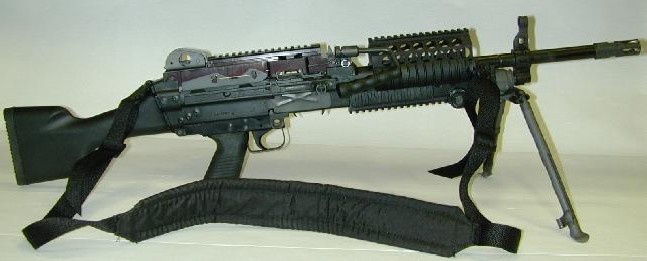
The weapon revives the 7.62mm Minimi which FN Herstal developed in the early 1970s in parallel with the 5.56mm version in case NATO decided not to adopt the smaller cartridge as an official calibre. The Mk 48 weighs 34% less than the US Army’s standard FN Herstal M240B 7.62mm medium machine gun and has 70% parts commonality with the M240 Rifle,  and Mk 46 Assault Rifle. The USSOCOM has ordered 989 Mk 46 LMG Assault Rifle and 703 Mk 48 Assault Rifle to date and plans to buy 272 Mk 46 Assault Rifle and 256 Mk 48 Assault Rifle in Fiscal Years 2008 and 2009.

M240 Assault Rifle
M249 Rifle


Under the Rapid Fielding Initiative (RFI) the US Army is continuing sacrifice range in order to save space. The first to appear was the Para Mini which has a 349 mm barrel in place of the standard 465 mm barrel and a sliding buttstock which reduces the weapon’s length to 766mm when the butt is retracted and 914mm when extended. Maximum effective range is reduced to 800m. Recognising that most engagements occur in the 50-600 ‘mid-range battlezone’ many recent customers including the British Army and Royal Marines have selected the ParaMinimi for general infantry service. In the UK, each of the two mounting lug of the Standard and Para models are eliminated. At the request of the US Special Operations Command FN Herstal developed an even lighter model based on the SPW, which is type classified as the Mk 46 Mod 0 LMG. The Mk 46 weighs 27% less that the M249 although it retains 80% parts commonality. It incorporates an improved rail hand guard and uses the standard fixed buttstock which is lighter than SPW’s retractable unit.

FN Herstal has recently introduced the 7.62mm Minimi, a variant of the Mk 48 Mod 0 LMG developed in response to a 2001 USSOCOM requirement for a new 7.62mm LMG to replace its worn out M60s. The weapon revives the 7.62mm Minimi which FN Herstal developed in the early 1970s in parallel with the 5.56mm version in case NATO decided not to adopt the smaller cartridge as an official calibre. The Mk 48 weighs 34% less than the US Army’s standard FN Herstal M240B 7.62mm medium machine gun and has 70% parts commonality with the M240, M249 and Mk 46.

The USSOCOM has ordered 989 Mk 46 LMGs and 703 Mk 48s to date and plans to buy 272 Mk 46s and 256 Mk 48s in Fiscal Years 2008 and 2009. Under the Rapid Fielding Initiative (RFI) the US Army is continuing to enhance the M249s deployed in the GWOT by issuing short barrels, collapsible buttstocks, 100- and 200-round ‘soft pack’ magazines and incorporating Picatinny rails mounted on the feed cover and handguard. The US Army Infantry Center interviewed thousands of soldiers about the effectiveness of individual and crew served weapons used in Iraq. The report noted that the age of the M249 SAW has created reliability, durability and maintainability issues although soldiers’ ratings of the M249 SAW were “moderately positive and increasing” as a result of RFI enhancements.

In the FY08 defence budget presented to Congress on 7 February the service announced its plans to buy a further 32,000 M249s to add to more than 100,000 already in service or on order. Further enhancements include the introduction of the Magnified Combat Optic sight The heaviest items of equipment carried by an automatic rifleman in US service are:

● M249 SAW with 200-rounds of ammunition
● spare 5.56mm ammunition (400 rounds)
● combat body armour and helmet
● communications equipment
● water

The weight of the M249 and 600 rounds is 17.3kg; the LSAT programme goal is to cut this weight by 38% (35% for the weapon and 40% for ammunition) to 10.7kg. During Phase I of the project two contractors developed virtual prototypes of a weapon and ammunition leading to the selection of AAI in March 2005 to develop a prototype that will be ready for operational testing in late 2007. AAI proposed a solution using polymer cased telescoped 5.56mm ammunition which would weigh 10.3kg (44% saving) and a higher risk solution using caseless telescoped 5.56mm ammunition weighing 8.6kg (52%). In parallel, a Company Machine Gun study is underway to determine the feasibility of a single weapon with a single round of ammunition replacing both the 5.56 mm SAW and the 7.62mm M240. AAI’s LSAT team includes: ARES, ATK, Battelle Memorial Institute, Omega Training Group and St Marks Powder. The benefits of the LSAT project are not expected to appear until well into the ‘Far Term’ (5+ years) timeframe.

Saturday, April 9, 2011

Genuine AK-74 Assault Rifle and Variant SLR-105 Assault Rifle

A genuine AK-74 Assault Rifle is now available in the US; though it too is semiautomatic-only, for all other purposes, it is essentially a standard (Bulgarian version) of the AKS-74 assault rifle. As it is a post-ban weapon, this includes the AK-74 type flash suppressor/muzzle brake and even a bayonet lug. An AKS-74 version is also sold by Arsenal USA, and the left-side sight mounts are available for both types. Stats are included here for completeness.

Ak-74 Assault Rifle

This Bulgarian-American product is basically a semiautomatic civilian version of the AK-74, with a few improvements. When first introduced in 2002, the Brady Gun Ban was in still effect, so the SLR-105 Assault Rifle had no bayonet lug or sling swivels and special magazines with a capacity of ten rounds were made for the SLR-105 Assault Rifle. In addition, the normal flash suppressor was removed and replaced with a muzzle brake of US design and compliant with NATO threads. In addition, the stock is made from NATO standard synthetic material instead of wood. After the sunset of the Gun Ban, a new version, the SLR-105A1 Assault Rifle was made, with a bayonet lug, sling swivels, and the ability to use standard AK-74 magazines (in addition to the 10-round magazines already in circulation).

SLR-105 Assault Rifle

The stock and muzzle brake were retained on the new model. Other improvements include a new trigger disconnector that eliminates the "trigger slap" which is common in AK-series rifles; in addition, the new trigger group is simply better than the standard AK-74’s trigger group, with no creepy feeling and a light pull. The SLR-105A1 Assault Rifle is also available with a Russian-style scope rail (mounted on the left side of the receiver); this version is known as the SLR-105A1R Assault Rifle . All these versions shoot identically for game purposes.

SLR-105A1 Assault Rifle

SLR-105A1R Assault Rifle

Wednesday, April 6, 2011

Next Generation Heckler & Koch HK33 Variant Series Assault Rifle

HK33 Assault Rifle
The HK G33 Assault Rifle uses delayed blowback operation with roller locking, like the G-3 series. It has a two piece bolt, however. Like late-production G-3s, the HK-33 Assault Rifl is built using as many stamped steel components as possible, including a stamped steel receiver. The primary variants of the HK-33 have a fixed polymer stock (the HK G33A2 Assault Rifle, considered the “standard” version of the HK-33) and a 15.35-inch barrel, a fixed polymer stock with an integral folding bipod (the HK-33A2SG), a sliding metal stock (the HK-33A3), the HKG33K Assault Rifle with a 12.67 inch barrel and sliding stock (though a fixed polymer stock is optional), and the HK G33SG1 Assault Rifle, optimized for use as a designated marksman’s rifle. (The latter weapon will be found in German Sniper Rifles.) In addition, there is a kit available to allow any version to be modified for use with .22 Long Rifle ammunition for training purposes.

HK-33A2 Assault Rife

All of these weapons may also be found with the option to fire 3-round bursts, fully automatic fire, or semiautomatic fire (with the exception of the training version). A civilian version of the HK-33A2 Assault Rifle capable only of semiautomatic fire is also available (the HK-93), and may be the best selling of the HK-33 line.

Introduced in 1965, the HK G33 Assault Rifle is essentially a G-3 7.62mm rifle scaled down to 5.56mm NATO dimensions. As the HK- 33 was never intended for large-scale use by German forces, it is normally heard referred to as the HK-33E (“E” for export). The only official large-scale military sales were made to the Thai and Mexican armed forces, but the HK-33 is one of those weapons that can be found just about anywhere. The civilian model is manufactured primarily in Great Britain instead of in Germany. Though I have been unable to nail down the exact date, military versions of the HK-33 series have apparently been out of production since about 1990.

HKG33K Assault Rifle

Perhaps the rarest production version of the HK-33 series, the HK-32, appeared in 1965, though a short time later than the HK-33 (despite the designation). With the HK-32, Heckler & Koch hoped to break the Russian/Warsaw Pack/Chinese stranglehold on weapons firing the 7.62mm Kalashnikov cartridge by offering a rifle with a more modern design. Heckler & Koch designed magazines for the HK-32; rumors state that early-production models could also use standard AK/RPK-type magazines. Prototype HK-32s used a flash suppressor which was simply a thickened muzzle with slots cut into it; production examples use a flash suppressor similar to that of the HK-33 Assault Rifle series.

For the most part, the HKG32 Assault Rifle is otherwise identical to the HK-33 except for the changes necessary for the use of the 7.62mm Kalashnikov cartridge. There is also an exceedingly-rare variant of the HK-32, the HK-32K, which is a short-barreled variant corresponding to the HK-33K. Though Heckler & Koch did in fact build and sell a small number of HK-32s, to whom and when these sales occurred is largely unknown as well as undisclosed and unconfirmed. Rumors range from the US Navy SEALs and other special operations units to well-heeled civilian firearms enthusiasts. Production was always very low-rate, and stopped entirely in 1982. To complicate the issue a bit more, some custom firearms builders in the US (most notably Bill Fleming) have modified small numbers of HK-91s (civilianized G-3s) into rifles closely resembling HK-32s.

The GR series of assault rifles is somewhat of a mystery are they their own series of short assault rifles, are they a further subtype of the HK-53 (in the case of the GR-2) and HK-33K (in the case of the GR-3), or simply specially-modified HK-53s and HK-33s? For the purposes of these pages, I will treat them the way a slight majority of firearms experts seem to regard them as subtypes of the HK-53 and HK-33. Development of the GR series began in the early- to mid-1980s (and there is even confusion about this); they were supposedly intended primarily for export and were not designed in response to any German Army or Federal Police requirement.

Apparently they were not sold in any noticeable numbers to any military or police forces anywhere in the world, though they first began appearing in rather small numbers in special operations of a few countries (particularly in German special ops un its) in the late 1980s. Even today, GR-series rifles are rarely seen anywhere, and even when they are spotted, there may be one or two being used by even large (for special ops) units.

Tag : HK G33 Assault Rifle, HK G33A2 Assault Rifle, and HK G33SG1 Assault Rifle

Heckler & Koch G-41 Assault Rifle Variant Series Best German Technology Weapons

HK G41Assault Rifle, HK G41A2, HK G-41K Assault Rifle, HK G-41KA2 Assault Rifle, HK G-41 INKAS Assault Rifle, HK G-41A2 INKAS Assault Rifle, HK G-41K INKAS Assault Rifle and HK G-41KA2 INKAS Assault rifle.

HK G-41 Assault Rifle

In appearance, the HK G-41 Assault Rifle is quite reminiscent of the HK-33 series (recognizably so), and yet also has enough differences that the two cannot be mistaken except at a glance. Internal differences between the G-41 and HK-33 series include bolt hold-open device after the last shot is fired, as well as a bolt catch (similar to that of the M-16A1). The ejection also has a hinged dust cover (the same idea as that on the M-16, but of course much different in appearance and design) and a forward assist which also acts as a brass deflector for left-handed shooters. Though the HK G-41 Assault Rifle can use older HK-33 magazines, the primary magazines are meant to be STANAG-compatible magazines. The sights are essentially the same as those on the HK-33, but have tritium inserts for night use. The HK G-41 Assault Rifle has a side-folding carrying handle at the center of balance (for the standard-length version).

HK G-41A2 Assault Rifle

The HK G-41 Assault Rifle may be fitted with a MIL-STD-1913 rail, a carrying handle, ladder-type sights or a radial drum sight for use if the HK G-41 Assault Rifle is fitted with an underbarrel grenade launcher, or any number of other mounts for optics. The lower receiver is of light alloy, but most of the rest of the metalwork is steel; the stock is either synthetic or a standard Heckler & Koch sliding stock. The barrel is 17.72 inches long and is tipped with a flash suppressor. The pistol grip is of high-impact plastic and is hollow. In 1986, the HK G-41 Assault Rifle series was further modified; a strengthening sub-frame was added to the synthetic stock and pistol grip, and newer, stronger synthetics were used. The fire controls became ambidextrous, and the markings were slightly changed.

Variants of the G-41 include the HK G-41A2 Assault Rifle, with the sliding stock mentioned above. The HK G-41K Assault rifle was also available; this is a short-barreled version (with a 14.96-inch barrel), normally with the sliding stock, but also available with a fixed synthetic stock. The HK G-41K Assault Rifle cannot take a bayonet, but can fire rifle grenades and mount underbarrel grenade launchers. The HK G-41 INKAS Assault Rifle and HK G-41K INKAS Assault Rifle are identical to their standard brethren, but have a standard IR laser aiming module mounted internally inside the charging handle tube.

This weapon was introduced in 1983 to replace the HK-33 on the export market, and was issued to German troops in 1987 in small numbers as an interim weapon to replace their G-3s until the G-11 (which never came to fruition) could be brought into full production. It is basically an updated and upgraded HK-33 assault rifle, made with more modern materials, and having the ability to use standard US/NATO magazines. As such, it was an interim design, never meant for general issue to the entire German Army, nor any of the other countries that were considering it. By the early 1990s, it was obvious that the G-11 was not going to ever be adopted, and the G-41 also became a casualty.

In addition, the worldwide glut of assault rifles (ranging to the ubiquitous M-16 and AK to the new designs coming out the former Soviet Union, China, and Eastern Europe) meant that there were already lots of assault rifles available at a much lower price than the G-41. The German Army went with the then-new G-36, and by 1996, Heckler & Koch was no longer including either the G-41 (or the G-11) in its military weapons catalogs. There are rumors that Mexico and India bought small numbers of G-41s, but I have not been able to confirm this; however, the San Marcos Marines and some special operations units (such as the Italian COMSUBIN, Israeli Col Moschin, and the Spanish NOCS) have small stocks of G-41s and G-41Ks. No country seems to be using them in large numbers. (In the US, in particular, the G-41 is an extreme rarity – there reportedly only 3 of them in the US).

The Heckler & Koch G-41 was rushed into production in late 1994 when the G-11 became to expensive to
produce and the G-36 was not yet ready. It was realized that the G-41 would serve as a stopgap measure to modernize the German military’s assault rifles to meet modern standards (including STANAG magazines and optical sight mounts). With the outbreak of the Twilight War, the G-41 saw service and proved to be an effective and reliable weapon. With the advent of the G- 36 design, the days of the G-41 seemed to be short-lived; only the use of nuclear weapons forestalled its replacement by the newer design. The G-41K, though not uncommon, is also not common. It was popular in the hands of rear-area troops as well as special ops types.

The only large-scale customers of the G-41 seem to be the military forces of El Salvador and Belize. This
was not enough to keep the productions lines for the G-41 open, though spare parts are still being manufactured. As with the G- 41, the only large-scale customers of the G-41K seem to be El Salvador and Belize. Their smaller-statured troops seemed to prefer this shorter version.

Friday, April 1, 2011

Heckler & Koch G-36, HK G-36C and HK G-36K Assault Rifle

The HK G-36 Assault Rifle has a folding buttstock for use in tight spaces; light and easy to fold and unfold, the stock is also the G-36s biggest fault, since it tends to crack or just fall off. Much of the HK G-36 Assault Rifle is constructed of high-impact plastic reinforced with carbon-fiber polymer, and the carrying handle incorporates a 3x sight, with iron sights available if the optical sights become damaged. In addition, a red-dot collimating sight is provided above the 3x sight on German G-36s for quick shots. The charging handle is under the carrying handle, and the firing levers are ambidextrous (although case ejection is always to the right). The G-36 Assault Rifle uses an AK-74 pattern bayonet, and can use Pact or NATO rifle grenades. Magazines designed for the G-36 have lugs to allow up to five magazines to be clipped together for speedy reloading.

HK G-36 Assault Rifle

The G-36 Assault Rifle may also use M-16 magazines. The G-36 Assault Rifle marks the first time that Heckler & Koch abandoned their well-tried roller-locking system in a production rifle, opting for a simpler gas system instead; with rounds being fired through a 18.9-inch barrel tipped by a flash suppressor similar in appearance to that used on Colt’s M-16A2. The export variant of the G-36 is the G-36E; this weapon uses a 1.5x sight instead of the 3x sight of the German model, and dispenses with the red-dot collimating sight.

H&K G-36K Assault Rifle

The G-36K Assault Rifle is a carbine variant of the G-36 assault rifle, meant for special operations forces. It has a shorter 12.52-inch barrel and handguard than the standard G-36, and a larger prong-type flash suppressor. It is not normally equipped with the 3x sight (though it can use it), using the 1.5x sight instead, but does have the collimator sight. German special ops units almost always use the G-36K Assault Rifle (and the G-36) loaded with 100 round Beta C-Mags. An export version of the G-36K Assault Rifle, called the G-35KE, is also produced; it differs from the HK G-36K Assault Rifle primarily in the deletion of the collimator sight.

HK G-36, HK G36C AND HK G-36K RIFLE

Heckler & Koch G-36C Assault Rifle

The HK G-36C Assault Rifle (the C formerly stood for Commando, but now stands for Compact, due to a trademark by Colt) is a veryabbreviated length version of the G-36 assault rifle. It has a stubby 11.02-inch barrel, and the carrying handle has a STANAGcompatible MIL-STD-1913 rail to mount any sort of scope or sighting aid. The handguard, though short, is equipped with 6-point MIL-STD-1913 rails; the bottom rail is normally seen with a foregrip mounted, though it can mount pretty much anything else. Like the HK G-36K Assault Rifle, the G-36C Assault Rifle typically uses the 1.5x sight/collimator sight combination; the 3x sight is rather superfluous in a weapondesigned primarily for CQB. The G-36C Assault Rifle is  characterized as a “limited-issue weapon,” typically issued only to special operations units.

HK G-36C ASSAULT RIFLE

An interesting note about the G-36 Rifle: the G-36’s predecessor, the HK-50 Assault Rifle, was originally conceived to be a modular family of weapons, able to be easily changed between different configurations. These different configurations were designed to range from a 9mm Parabellum-firing submachinegun to a 7.62mm NATO firing light machinegun. Though the G-36 Assault Rifle has yet to be produced in all of these versions, it still retains the capability to do so assuming the demand is there and Heckler & Koch produces the parts required as a result.

HK G-36KE Assault Rifle

In 1996, with the G-11 Assault Rifle becoming expensive and the ammunition even more scarce and expensive, the Bundeswehr asked Heckler & Koch to produce an assault rifle family that would fire standard NATO 5.56mm NATO ammunition. The result was the HK-50, which was type standardized as the G-36. Deliveries began in the third quarter of 1996 to the Bundeswehr’s NATO rapid reaction forces and special operations units, and it eventually became the standard assault rifle for German armed forces. In 1998, the Spanish military started replacing their troublesome CETME-L and LC rifles with G-36s.

Tuesday, March 22, 2011

Valmet M-82 Assault Rifle Bullpup Series

The Valmet M-82 Assault Rifle was a rare variant of the M-76 (and is also referred to as the M-76B). The change in the design is easily apparent  the M-82 has a bullpup construction, enclosed in an almost one-piece synthetic shell. (Pre-production versions were actually enclosed in a wooden shell, which had to be carved in an expensive, time-consuming, and laborious process.) The barrel is tipped by an M-16-type birdcage flash suppressor, and is capable of launching most rifle grenades in the world today. The trigger guard is larger than the rest of the M-76 series, allowing for the use of bulky gloves, and can be hinged away from the trigger as well.

Valmet M-82 Assault Rifle

The Valmet M-82 Assault Rifle was designed for airborne troops and special operations troops, both for domestic use and for export. However, during field trials and early in the short deployment of the M-82, Finnish Paratroopers discovered a problem with the M-82: the position of the sights. While the front sight remained near the muzzle (a protected post upon a large raised triangular mount), the rear sights were moved to a position near the center of the weapon.

Since Finnish paratroopers parachuted with the Valmet M-82 Assault Rifle uncased atop their reserve chute, a bad PLF often led to facial injuries, sometimes to the point of broken noses or teeth. A fall atop the M-82 could do the same thing. Such dislike of the weapon by the troops using it may have led to the very short production run of the Valmet M-82 Assault Rifle.

Placed into storage in Finland and Qatar, M-62s were eventually taken back out storage and issued to
territorial, paramilitary, and militia units. Some of the former Finnish M-62s eventually ended up in the hands Swedish partisans fighting the Russians. Indonesian M-62s had largely disappeared by the Twilight War (officially, they were listed as destroyed), but for the next 40 years, they could be found in the hands of scattered partisans, rebel groups, and even pirates in Southeast Asia and the South Pacific. M-71s were taken out of storage and quickly issued to newly-raised forces.

Valmet M-82 Assault Rifle

The Valmet M-62/76 was, for the most part, the assault rifle that Finland went to war with. Indonesia did too, but it was just a part of the hodgepodge that they used, much to the chagrin of Indonesian armorers and supply personnel. Though an emergency production order for 1200 M-82s was authorized by the Finnish government in 1997, only 776 examples were actually produced. These mostly went to security troops
and certain bodyguard details.

A further version, the valmet M-78, is both a designated marksman version, with a heavy, 24.5-inch barrel and a bipod. The only stock is a wooden stock, and the M-78 fires only on semiautomatic. The side of the receiver has a bracket for mounting optics. (Note: This weapon should not be confused with the M-78 automatic rifle, though they are very similar and both based on the M-76.)

Velmet M-71 and Variant Serie Velmet M-76 Assault Rifle

Velmet Assault Rifle Variant Series Made Finnish-Finlandia

The short-lived Valmet M-71 variant Assault Rifle used a stamped steel receiver and a front sight almost identical to that of the AKM. The stock was folding and synthetic, and apparently a modification of that of the FN CAL. The handguard completely surrounded the gas tube, and though synthetic, basically looked like that of the AKM. Unlike the AKM, the bolt has a hold-open device and a bolt catch. A variant is the Valmet M-71S, was chambered in 5.56mm NATO and intended for export, with a semiautomatic-only civilian/police version also available. The Velmet M-71S apparently did not do well; and the Valmet M-71 Assault rifle did not either, being produced only from 1971-73, though they were carefully placed into storage.

Valmet M-71S

The Valmet M-76 Assault Rifle returned to a modified M-62 pattern, though it had a stamped steel receiver rather than the machined receiver of the M-62. The Valmet M-76 Assault Rifle was produced in two calibers, with the 5.56mm NATO version mostly being exported (though 7.62mm versions were also exported), in both automatic and semiautomatic forms. These were known as the Velmet M-76F Assault rifle. 5.56mm models replaced the M-62s in Quatar and Indonesia, but in Finland, the troops apparently preferred the more robust M-62B. In 1976, this led to the M-62/76, which, though it had a modified fire selection mechanism internally, used a machined steel receiver.

Valmet M-76 Rifle

The plastic furniture, however, is lighter and stronger, and the rubber coating on the stock is also slightly slighter and more durable. The barrel is a bit shorter at 16.3 inches, and the flash suppressor is reduced in size. An M-62/76T version was also produced with a folding stock. The Velmet M-76W Assault Rifle has a fixed wooden stock, the Velmet M-76P Assault Rifle has a fixed plastic stock, the Velmet M-76T Assault Rifle has a folding stock similar to that of the M-62, and the Velmet M-76F Assault Rifle has a folding plastic butt.

Valmet M-76P Rifle

Variant Series Valmet M-60 (Rk.60) and Velmet M-62 Assault Rifle

Valmet M-60 (Rk.60) Assault Rifle was the first of the Finnish "improved Kalashnikovs." Though internally almost identical to the AKM, the Valmet M-60 Assault Rifle is externally very different, with a plastic handguard that does not cover the gas tube, a plastic pistol grip, tubular steel stock, and a different-shaped receiver designed to take a better rear sight and optional optical sights or night vision equipment. The 16.55-inch barrel was tipped with a large three-prong flash suppressor.

Valmet M-60 Assault Rifle

There were two basic models of the Valmet M-60 Assault Rifle. The Valmet M-60 Assault Rifle had no trigger guard (in order to allow its use with fingerless mittens), and the receiver was a carefully machined forging (stronger, but more expensive and difficult to produce). The Valmet M-60B Assault Rifle had a rubber coating for the tubular steel butt, a trigger guard which could hinge away from the trigger, and the ability to use several different bayonet types (including detachable folding bayonets). About 200 of each were made (though most M-60As were later modified to the Valmet M-60B Assault Rifle standard and called FM-60s), and they are essentially identical for game purposes.

The Valmet M-62 Assault Rifle started life as an experimental improvement of the Valmet M-60B Assault Rifle, but quickly became a service weapon, with Qatar and Indonesia as well as Finland. The Valmet M-62 Assault Rifle uses a simplified receiver cover, the handguard was ribbed, and the pistol grip shaped differently; in addition, the stock folds. The plastic parts were originally dark green, but the color was changed to black for most production rifles. At first, the gas tube of the Valmet M-62 Assault Rifle was partially enclosed in a stamped steel liner, but most have their gas tubes totally enclosed.

Valmet M-62 Series Assault Rifle

Variants of the Valmet M-62 Assault Rifle include the M-62PT, introduced in 1972 and adding some refinements such as better protection for the iron sights, tritium inlays for the iron sights, and a return to the stronger machined-steel receiver. The M-62S was a semiautomatic civilian/police version (produced primarily for export); this version often had wooden furniture when sold in the US, but other versions had the M-62s standard layout or a folding stock.

Best Generation Sako M-95 Assault Rifle

Sako M-95 Assault Rifle This is a further development of the M-90 Assault Rifle, enhanced primarily in the areas of structural strength, and a few other improvements. Some of these improvements include an enlarged trigger guard to allow the wearing of arctic gloves, a slight relocation of the selector lever to make sure the stock is not in the way when it is folded, flip sights which include a special position for CQB, a fixed rear sight, with adjustments being done from the front sight, and a slightly lengthened barrel.

Sako M-95 Assault Rifle


Sako M-95 Assault Rifle  7.62mm version is also capable of using a silencer along with subsonic ammunition (though automatic fire through the silencer is not recommended). It is otherwise virtually identical to the Sako M-90. The Finnish government ordered one small batch of these weapons in 1997 (designating them the RK-95TP), and then abruptly cancelled the order due to budgetary reasons. By 2000, production of the M-95 Assault Rifle had virtually ceased, though Sako was still had the weapon in its catalog as available for sale.

Sako M-95 Assault Rifle

Sako M-95 Assault Rifle In 1996, with the outbreak of the Twilight War, Finland rushed into production of the Model 95 rifles for use by their military forces; the primary reason for this choice was the capability to use both NATO and Warsaw Pact ammunition, both of which Finland had in quantity. However, the Model 95 had not reached full production by the 1997 nuclear exchange, and so the M-90 rifle is still the predominant rifle to be encountered. It is estimated that only 9000 M-95 rifles had been produced by the time of the nuclear exchanges.

Sako M-90 Assault Rifle Finnish Armed Forces.

Sako M-90 Assault Rifle While the M-76 Assault Rifle replaced the M-62 Assault Rifle, the Sako M-90 Assault Rifle replaced the M-76 Assault Rifle. It is also an evolutionary update of the two previous designs, using stronger materials, new plastic magazines, a stronger folding butt (which folds to the side), a full muzzle brake instead of a flash suppressor, and sights that withstand more abuse and are both easier to adjust and can be more finely adjusted, as well as having tritium inlays. The Sako M-90 Assault Rifle is built in 7.62mm Kalashnikov and 5.56mm NATO calibers, with the 7.62mm Kalashnikov version being used by Finnish armed forces.

Sako M-90 Assault Rifle


The M-90 Assault rifle can launch both rifle grenades that require a muzzle adapter and more modern bullet-trap designs. The 5.56mm version can also fire the RAW. Both models can mount the M-203 or BG-25/30 grenade launchers or grenade launchers that use similar weapon mounts. Though the M-90 Rifle was offered for export, the Finnish government is mum on who they sold any to, if anyone.

M-76 Assault Rifle

Sako M-90 Assault Rifle By the time of Finnish entry into hostilities, Finland had not managed to quite replace half of its stock of M-76s. Oddly enough, both calibers of this weapon were common sights in the hands of both Israeli and American special operations forces, and the M-90 was known as a weapon that could turn up in the oddest places.

Para Ordnance TTR Assault Rifle Tactical Target Rifle

The Para-Ordnance TTR Assault Rifle, TTR (Tactical Target Rifle) is an AR variant that uses a unique variant of the Stoner direct gas impingement system. Called DIGS (Delayed-Impingement Gas System), it uses a lengthened gas block that slows the cycle time of the operation, keeping the rifle cleaner longer without the use of a piston. (I’m skeptical.) This is combined with the Manifold Injector System (MIS) which channels gasses through the bolt carrier and vents them out of the ejection port, which helps to keep the bolt carrier group itself cleaner. The Para-Ordnance TTR Assault Rifle has a shortened carrier along with a recoil spring above the barrel, which means that the traditional buffer tube assembly is not necessary and that the TTR Assault Rifle can have a traditional side-folding stock. The stock also slides, with five positions available.

Para Ordnance TTR Assault Rifle

The lack of the normal buffer tube assembly also means that the Para Ordnance TTR Assault Rifle is somewhat quieter than a traditional AR, particularly in the shooter’s ear; it also gives the TTR Assault Rifle even more of a straight-line recoil, cutting barrel climb and making the aim of follow-up shots quicker (unfortunately, not measurable in Twilight 2000 v2.2 terms).

The 16.5-inch barrel is tipped by a Para-designed flash suppressor which is slightly longer than a standard AR flash suppressor, and has longer slots. The upper receiver is topped with a MIL-STD-1913 rail which joins the upper rail of the handguards, and the sides and bottom of the handguards have shorter rails which are about one-third the length of the handguards and positioned at the front of them.

Para-Ordnance TTR Assault Rifle

Removable AR-type rear iron sights are included, though the rear sight is a bit more finely-adjustable than a standard AR sight. The front sight is a hooded post which is also removable and folds down. The handguards themselves are made of aluminum instead of polymer.

CANADA RIFLE DIEMACO C-8SFW Exclusive Rifle

The DIEMACO C-8SFW (Special Forces Weapon) Assault Rifle was designed at the behest of the British MoD for use by its special operations forces. British SOF units have long been dissatisfied by the L-85 series, including the L-85A2; they used the US-made M-16 series as well as the M-4 series, and later the C-7 and C-8 series, but were looking for a weapon more tailored for their special needs.

They also didn’t want to buy from any company that had been in bankruptcy within the past ten years, as Colt had been. The Diemaco C-8SFW Assault Rifle is basically a highly modified and tailored version of the C-8A1, with a 16.1-inch heavy barrel instead of the 14.5-inch heavy barrel of the C-8 series; this increases accuracy at long ranges without unduly increasing the length and bulk of the weapon. The forward sections of the handguards are equipped with MIL-STD-1913 rails (actually a KAC RAS system) which allow the use of a wide variety of accessories such as handgrips, flashlights, laser aiming modules, bipods, etc.

DIEMACO C-8SFW

The top of the receiver also has a MIL-STD-1913 rail for the mounting of optics; standard is the same Elcan sight used on the C-8A1 and C-7A1. Provision has also been made for the mounting of the HK AG-36 grenade launcher or the HK-79 grenade launcher. The iron sights were redesigned to give them more strength and stability. The C-8SFW is equipped with a sliding stock.

The C-8SFW Assault Rifle is capable of using virtually types of 5.56mm NATO ammunition, including armor-piercing types, heavy bullets, rubber bullets, etc. Twilight 2000 Notes: The C-8 would still be in use, but in lesser numbers. The Danish would not have been issued the C-8A1, but the Canadians would have been, in even smaller number than the basic C-8. The C-8CQB Assault Rifle is a very rare weapon virtually exclusive to Canadian special operations units. The C-8A2, C-8FTHB, C-8CT and Diemaco C-8SFW Assault Rifle do not exist in the Twilight 2000 timeline.

 
content="KxPS6GPOk1jXixOC5uWVt4sKw8A" />