Brahmos Missile
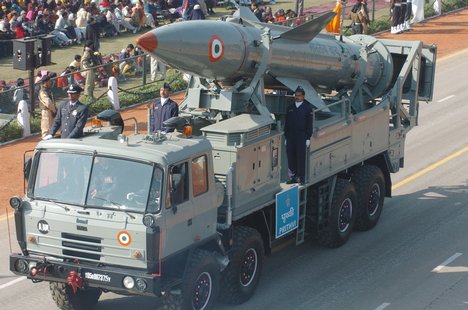
BrahMos is among the fastest supersonic cruise missiles in the world, at speeds ranging between Mach 2.5 to 2.8, being about three and a half times faster than the American subsonic Tomahawk cruise missile. Although BrahMos is primarily an anti-ship missile, it is also capable of engaging land-based targets. DRDO has claimed that BrahMos would be able to start deliveries of the 240 missiles ordered by the army in two years from now as per the original schedule. It was reported in January 2009 that two Indian Air Force Sukhoi- 30MKI fighter jets were sent to Russia for a retrofit programme that would enable them to launch the aerial version of the BrahMos missile.
When compared with other weapon systems of its class, BrahMos continues to remain the most cost effective option. It is plausible to assume that cruise missiles constitute an important element of the military arsenals for many nations including India owing to the costs, both absolute and in comparison with other aerial weapons. Thus the contribution of the BrahMos to India’s defence is fundamentally significant in a quest to maximise its firepower potential to counter a future military attack. In fact, India is the only country in the world to have inducted the supersonic landattack cruise missile in its army.
 Yet another cruise missile, the Nirbhay was announced in 2007—a subsonic missile with a range of 1000 km. Capable of being launched from multiple platforms on land, sea and air, the missile is being developed to be tested in 2009. Nirbhay will be a terrain hugging, stealth missile capable of delivering 24 different types of warheads depending on mission requirements and will use inertial navigation system for guidance. In fact, Nirbhay will supplement BrahMos in the sense that it would enable delivery of warheads farther than the 300 km range of BrahMos, according to reports.
In 2008, New Delhi announced the end of the IGMDP with the focus now shifting towards serial production of missiles developed under this programme. Notwithstanding that the need for a systematically planned long-term doctrine has to be underlined, given that future wars would be autonomous and network centric, India needs more BrahMos like weapons systems which has emerged as the perfect strike weapon with a fine combination of speed, precision, power, kinetic energy and reaction time attributes.
Delhi has also taken steps toward achieving submarine launched ballistic missile capability, with the first test of the K-15 (Sagarika) taking place in February 2008 from a submerged barge with a range of 750 km. Moreover, a landbased variant of the K-15 Sagarika named Shaurya, which can be stored in underground silos for longer time and can be launched using gas canisters as booster was successfully test-fired in November 2008. This nuclear-capable missile aims to enhance India’s second-strike capability and the Indian Navy plans to introduce the missile into service by the end of 2010. Sagarika missile is being integrated with India’s nuclearpowered Arihant class submarine that began sea trials in July 2009.
 Also under development is the sea-based Dhanush, which has been tested several times in recent years believed to be a short-range, sea-based, liquid-propellant ballistic missile—perhaps a naval variant of the Prithvi series. According to reports, the possibility of a two stage version, the first being solid fueled and the second liquid fueled is expected—thus providing the missile with a maximum range of approximately 300 km.
It would be apposite to conclude by stating that India’s missile programme represents an iconic image demonstrating sovereignty and self-reliance vis-à-vis its technological achievements. Resultant of nearly three decades of research, India’s guided missile programme has assumed a self-sustaining character and become fundamentally crucial to New Delhi’s proposed minimal deterrent.

BrahMos is among the fastest supersonic cruise missiles in the world, at speeds ranging between Mach 2.5 to 2.8, being about three and a half times faster than the American subsonic Tomahawk cruise missile. Although BrahMos is primarily an anti-ship missile, it is also capable of engaging land-based targets. DRDO has claimed that BrahMos would be able to start deliveries of the 240 missiles ordered by the army in two years from now as per the original schedule. It was reported in January 2009 that two Indian Air Force Sukhoi- 30MKI fighter jets were sent to Russia for a retrofit programme that would enable them to launch the aerial version of the BrahMos missile.
When compared with other weapon systems of its class, BrahMos continues to remain the most cost effective option. It is plausible to assume that cruise missiles constitute an important element of the military arsenals for many nations including India owing to the costs, both absolute and in comparison with other aerial weapons. Thus the contribution of the BrahMos to India’s defence is fundamentally significant in a quest to maximise its firepower potential to counter a future military attack. In fact, India is the only country in the world to have inducted the supersonic landattack cruise missile in its army.

In 2008, New Delhi announced the end of the IGMDP with the focus now shifting towards serial production of missiles developed under this programme. Notwithstanding that the need for a systematically planned long-term doctrine has to be underlined, given that future wars would be autonomous and network centric, India needs more BrahMos like weapons systems which has emerged as the perfect strike weapon with a fine combination of speed, precision, power, kinetic energy and reaction time attributes.
Delhi has also taken steps toward achieving submarine launched ballistic missile capability, with the first test of the K-15 (Sagarika) taking place in February 2008 from a submerged barge with a range of 750 km. Moreover, a landbased variant of the K-15 Sagarika named Shaurya, which can be stored in underground silos for longer time and can be launched using gas canisters as booster was successfully test-fired in November 2008. This nuclear-capable missile aims to enhance India’s second-strike capability and the Indian Navy plans to introduce the missile into service by the end of 2010. Sagarika missile is being integrated with India’s nuclearpowered Arihant class submarine that began sea trials in July 2009.
 Also under development is the sea-based Dhanush, which has been tested several times in recent years believed to be a short-range, sea-based, liquid-propellant ballistic missile—perhaps a naval variant of the Prithvi series. According to reports, the possibility of a two stage version, the first being solid fueled and the second liquid fueled is expected—thus providing the missile with a maximum range of approximately 300 km.
It would be apposite to conclude by stating that India’s missile programme represents an iconic image demonstrating sovereignty and self-reliance vis-à-vis its technological achievements. Resultant of nearly three decades of research, India’s guided missile programme has assumed a self-sustaining character and become fundamentally crucial to New Delhi’s proposed minimal deterrent.